

What's Happening?
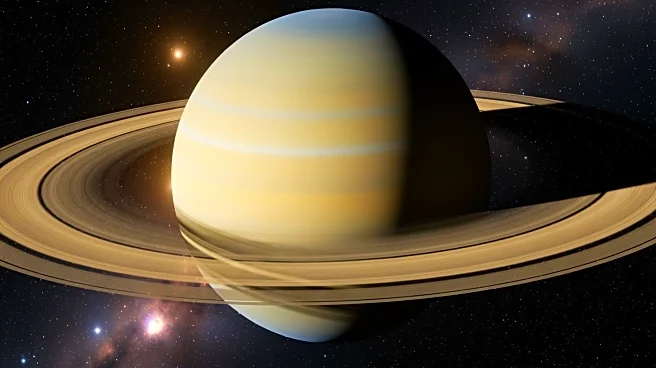
NASA has unveiled new, detailed images of Saturn, captured through the combined efforts of the Hubble Space Telescope and the James Webb Space Telescope (JWST). These images provide an unprecedented view of Saturn's atmosphere and rings, utilizing infrared,
visible, and ultraviolet wavelengths. The collaboration between these two telescopes has allowed scientists to gain a deeper understanding of Saturn's dynamic system, revealing intricate details of its atmosphere and ring structures. Hubble's visible-light images highlight Saturn's cloud bands and atmospheric patterns, while JWST's infrared capabilities offer insights into the temperature distribution and hidden structures beneath the cloud layers. This comprehensive view helps scientists visualize Saturn as a multi-layered world, enhancing the study of its atmospheric and seasonal changes.
Why It's Important?
The detailed images of Saturn are significant for several reasons. They provide a richer understanding of the planet's atmosphere and ring system, which are crucial for studying its climate and seasonal changes. Saturn's year lasts about 29 Earth years, and its seasons change gradually, affecting its atmosphere and rings. The data from Hubble and JWST will help refine models of Saturn's climate, offering insights into how the planet evolves over time. This research not only enhances our knowledge of Saturn but also contributes to the broader study of planetary atmospheres, aiding in the understanding of other gas giants in our solar system and beyond. The collaboration between Hubble and JWST exemplifies the power of combining different observational technologies to achieve a more comprehensive scientific understanding.
What's Next?
As Saturn approaches its 2025 equinox, scientists will continue to use the data from Hubble and JWST to study the planet's seasonal shifts and atmospheric patterns. This ongoing research will allow for the refinement of climate models and a more complete view of Saturn's evolution. The insights gained from this study may also inform future missions to Saturn and other gas giants, as well as enhance our understanding of exoplanetary systems. The continued collaboration between different telescopic technologies will likely lead to further breakthroughs in planetary science.