
What's Happening?
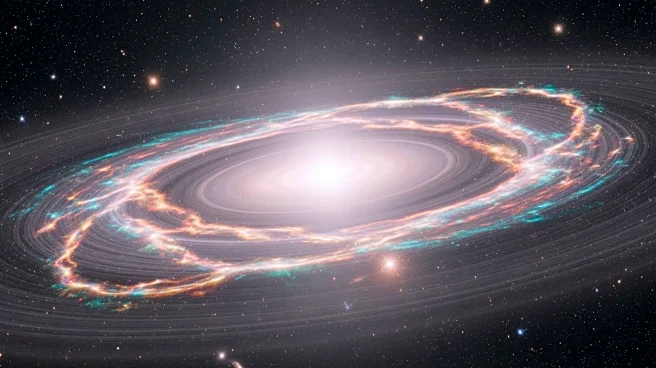
Astronomers using NASA's Hubble Space Telescope have captured images of the largest protoplanetary disk ever observed, circling a young star named IRAS 23077+6707. This disk, located roughly 1,000 light-years
from Earth, spans nearly 400 billion miles and is characterized by its chaotic and turbulent nature. The disk's peculiar structure, with filament-like features visible only on one side, suggests dynamic processes are shaping it. The findings, published in The Astrophysical Journal, provide a unique perspective on planet formation in extreme environments. The disk's mass is estimated to be 10 to 30 times that of Jupiter, indicating potential for forming multiple gas giants.
Why It's Important?
The discovery of such a massive and chaotic protoplanetary disk is significant as it challenges existing theories about planet formation. It provides astronomers with a new laboratory to study the birth of planetary systems, potentially offering insights into the early stages of our solar system. The asymmetric features of the disk suggest complex interactions that could redefine understanding of how planets emerge from disks of gas and dust. This research could influence future studies on planet formation and the conditions necessary for creating habitable worlds.
What's Next?
Further observations and studies are expected to focus on understanding the dynamic processes shaping the disk. Astronomers may use both Hubble and the James Webb Space Telescope to explore similar structures in other disks, aiming to uncover the mechanisms behind planet formation. The findings could lead to new models of planetary system development, influencing future space missions and research initiatives.
Beyond the Headlines
The peculiar nickname 'Dracula's Chivito' reflects the cultural heritage of the researchers involved, adding a human element to the scientific discovery. The disk's hamburger-like appearance, with a dark central lane flanked by glowing layers, offers a visually striking representation of cosmic phenomena. This discovery underscores the importance of international collaboration in advancing space exploration and understanding the universe.