



What's Happening?
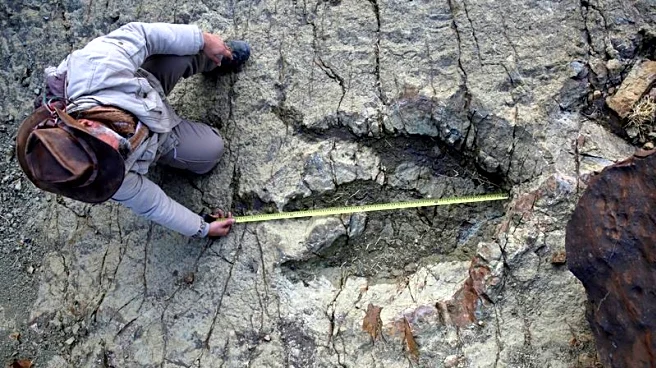
An international research team, led by scientists from La Trobe University and the University of Cambridge, is challenging the classification of the Little Foot fossil, a 3.67-million-year-old Australopithecus skeleton found in South Africa. Initially
identified as Australopithecus prometheus, new analysis suggests it may not belong to any known species, potentially representing a new human ancestor. The fossil, discovered in the Sterkfontein Caves, has been pivotal in understanding early human diversity and adaptation in southern Africa. The study, published in the American Journal of Biological Anthropology, highlights the need for a revised taxonomy in human evolution.
Why It's Important?
The reclassification of the Little Foot fossil could significantly alter the understanding of human evolutionary history. By potentially identifying a new species, scientists can gain insights into the diversity and adaptability of early human ancestors. This discovery underscores the complexity of human evolution and the importance of accurate species classification. It also highlights the role of southern Africa as a critical region for studying early hominins, offering clues about how ancient relatives adapted to diverse environments. The findings could influence future research directions and methodologies in paleoanthropology.