

What's Happening?
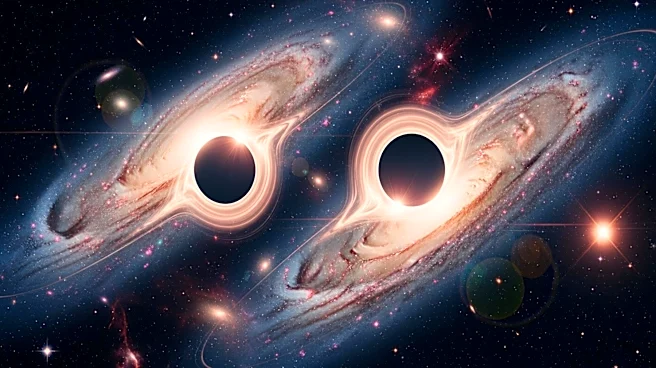
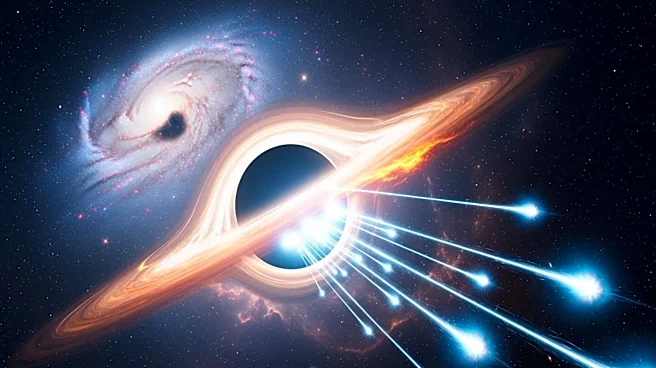
Astronomers have discovered that the angle at which galaxies collide significantly affects whether their central supermassive black holes will merge. Research led by Sena Ghobadi at the Georgia Institute of Technology used three-dimensional dynamic models
to simulate galaxy collisions. The study found that if the orbit of an accreting black hole is inclined by more than 45 degrees relative to the other black hole's disk, the merger is unlikely to occur within the universe's current age. This discovery highlights the importance of collision geometry in the merging process of supermassive black holes, which are key sources of gravitational waves.
Why It's Important?
Understanding the factors that influence supermassive black hole mergers is crucial for astrophysics, as these events are significant sources of gravitational waves. The study's findings provide new insights into the conditions necessary for such mergers, which can help refine models of galaxy evolution and the formation of cosmic structures. This research also has implications for the detection of gravitational waves, as it suggests that only certain types of galaxy collisions will produce detectable signals. This knowledge could guide future observations and improve the accuracy of gravitational wave predictions.
What's Next?
Further research will focus on observing galaxy collisions to test the study's predictions and refine models of black hole mergers. Astronomers will use data from observatories like the Chandra X-ray Observatory and the James Webb Space Telescope to study these events in greater detail. The findings could lead to a better understanding of the role of supermassive black holes in galaxy formation and evolution, as well as improve the detection and analysis of gravitational waves.