








What's Happening?
Berlin's Abgeordnetenhaus serves as a unique legislative body, functioning simultaneously as the state parliament and the municipal city council for the German capital. This dual role means it handles both state-level constitutional governance, such as policing,
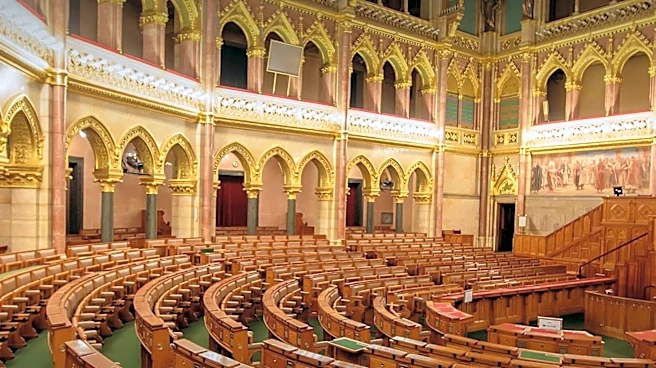
education, and housing policy, and municipal duties, including public transit contracts, waste management, and regional zoning plans. Unlike American governance where city halls and state capitols are separate, Berlin's system combines these two tiers into a single chamber. The Abgeordnetenhaus passes local statutes, approves multi-billion-euro budgets, and elects the Governing Mayor, who leads the city administration. This structure requires the legislative assembly to balance broad constitutional standards with immediate neighborhood issues. The assembly convenes in the historic Prussian Landtag building and its elections occur every five years using a mixed-member proportional representation system, ensuring proportional representation across the chamber.
Why It's Important?
This unique governance structure in Berlin offers a distinct model for managing urban centers, contrasting sharply with typical U.S. legislative frameworks. For American observers, understanding the Abgeordnetenhaus reveals how European democracies can integrate hyper-local neighborhood concerns with national capital interests within a single legislative body. This fusion of roles could be seen as a more streamlined approach to urban governance, potentially reducing bureaucratic overlap between state and municipal authorities. The system's emphasis on proportional representation in elections also highlights a different approach to ensuring fair political representation compared to the U.S. system, which often faces challenges like gerrymandering. The continuous confidence and majority backing required for Berlin's Governing Mayor to pass policy initiatives also presents a different dynamic of executive power compared to American state executives, who often hold veto powers. This model could offer insights for U.S. cities grappling with complex urban planning, resource allocation, and political representation issues.
What's Next?
The Abgeordnetenhaus will continue its dual function, navigating the complexities of both state and municipal governance. Its legislative calendar will involve drafting primary legislation on critical state-level issues like education and housing, while simultaneously overseeing essential municipal services such as public transit and waste management. The electoral framework, which ensures proportional representation, will continue to shape the political landscape of Berlin, with elections occurring every five years. Future policy initiatives will depend on the continuous confidence and majority backing of the parliamentary floor for the Governing Mayor's executive cabinet. The ongoing reconciliation of broad constitutional standards with immediate neighborhood needs will remain a central challenge and characteristic of Berlin's legislative process. International observers may continue to study this model for its effectiveness in balancing diverse governance responsibilities.
Beyond the Headlines
The Abgeordnetenhaus's integrated approach to governance challenges the conventional separation of powers often seen in federal systems, including that of the United States. This model suggests a deeper philosophical commitment to unified urban management, where the capital's identity as both a state and a city is reflected in its legislative structure. The historical context of the Prussian Landtag building, which survived significant political upheavals and reunification, underscores the resilience and adaptability of Berlin's institutional framework. The system's design, particularly its proportional representation, aims to mitigate political fragmentation and ensure that diverse voices are heard, potentially fostering greater civic engagement and trust in government. This integrated model could inspire discussions in the U.S. about alternative governance structures for major metropolitan areas, especially those that serve as state capitals, prompting a re-evaluation of how local and state interests are balanced and represented.