
What's Happening?
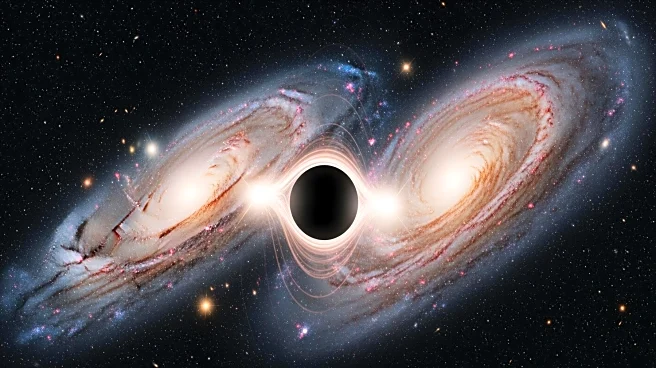
The Euclid space telescope has revealed that galaxy mergers significantly contribute to the activation of supermassive black holes. Using an artificial intelligence tool, researchers analyzed one million
galaxies to understand the conditions under which a galaxy develops an active galactic nucleus (AGN). The study found that early-stage mergers, characterized by heavy dust, showed six times more AGN activity compared to non-merging systems. This suggests that mergers push gas toward the center of galaxies, activating the black hole. The findings provide new insights into galaxy evolution and the role of mergers in feeding luminous AGN.
Why It's Important?
Understanding the activation of AGN is crucial for modeling galaxy evolution. AGN represent periods of rapid growth for supermassive black holes, affecting a galaxy's ability to form stars. The Euclid telescope's findings highlight mergers as a primary trigger for AGN, offering a consistent method to measure black hole activity across a large dataset. This research enhances our understanding of how gas moves through galaxies and how black holes grow over cosmic history. The use of AI tools in this study also demonstrates the potential for processing large astronomical datasets, expanding the scope of galaxies that can be studied.
What's Next?
As Euclid continues its mission, further observations are expected to refine our understanding of galaxy mergers and AGN activity. The study's methodology could be applied to other datasets, potentially revealing more about the conditions that lead to black hole activation. Researchers may also explore the implications of these findings for other cosmic phenomena, such as the formation of stars and the distribution of matter in the universe. The continued use of AI in astronomical research could lead to more discoveries about the fundamental processes governing galaxy evolution.