





What's Happening?
Two major forecasts released in October present differing outlooks on food prices for 2027. The U.S. Department of Agriculture (USDA) anticipates a modest 1% increase in grocery prices for 2027. In contrast, the World Bank projects that raw food commodity
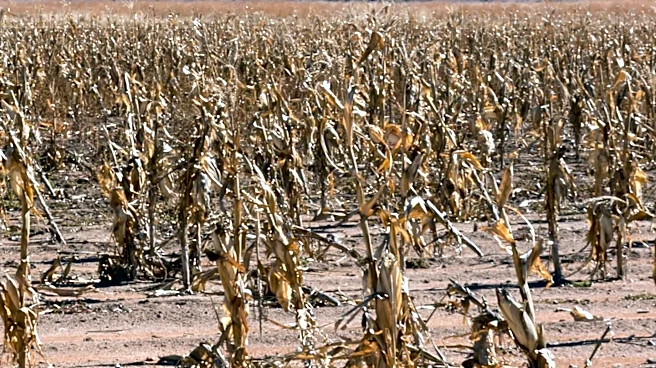
prices will rise by approximately 7% in 2027, following an estimated 10% increase in 2026, totaling an 18% rise over two years. The World Bank's forecast is based on factors such as oil, fertilizer, and grain markets, including potential disruptions to Black Sea grain shipments, the impact of El Niño on harvests, and high fuel and fertilizer costs. The USDA's forecast, updated on October 23, 2026, uses time-series models based on recent price index figures and does not account for new shocks. The World Bank's Commodity Markets Outlook, dated October 28, 2026, specifically considers a 'bad case' scenario where energy disruptions, attacks on Black Sea grain shipments, and a strong El Niño converge, potentially leading to food commodity prices 12% higher than its baseline forecast, surpassing 2022 levels.
Why It's Important?
The discrepancy between the USDA and World Bank forecasts highlights the complex layers of the food supply chain and the different metrics used to assess price changes. The World Bank focuses on raw commodity prices, which are influenced by global events like geopolitical conflicts, climate patterns, and input costs such as fuel and fertilizer. These factors directly affect farmers and initial producers. The USDA, however, measures prices at the consumer level in U.S. shops and restaurants, where raw commodity costs are only one component. The 'farm share' of every dollar spent on U.S. food is relatively small (11.8 cents for all food, 18.5 cents for food cooked at home), with the majority going to processing, packaging, transportation, energy, and retail. This means a significant rise in raw commodity prices might translate into a smaller, delayed increase at the grocery store. However, energy costs, which are a major driver in the World Bank's outlook, permeate every stage of the supply chain, suggesting that even a small percentage increase in raw materials can have a cumulative effect on final consumer prices. This divergence in forecasts can create uncertainty for consumers, businesses, and policymakers regarding future food inflation and its impact on household budgets and economic stability.
What's Next?
Consumers should prepare for continued upward pressure on food prices, even if the exact magnitude remains uncertain due to the differing forecasts. The World Bank's more pessimistic outlook, driven by global supply chain vulnerabilities and climate concerns, suggests that the underlying costs of food production are likely to remain high. This could lead to sustained inflation in grocery aisles, potentially forcing consumers to adjust their purchasing habits, such as opting for cheaper protein sources or increasing their consumption of staple goods like potatoes and flour. For policymakers, the situation calls for close monitoring of both global commodity markets and domestic consumer price trends. Strategies to mitigate the impact of rising input costs on farmers and to enhance the resilience of the food supply chain, particularly against geopolitical and climate-related disruptions, may become increasingly important. The next USDA outlook, scheduled for November 24, will provide an updated perspective on U.S. food prices, which could offer further clarity on the trajectory of grocery costs.
Beyond the Headlines
The contrasting forecasts from the USDA and the World Bank underscore a fundamental challenge in economic prediction: the interplay between global commodity markets and localized consumer prices. This situation highlights the 'bullwhip effect' in supply chains, where small fluctuations at the raw material level can lead to larger, delayed impacts further down the chain. It also brings into focus the ethical and social implications of food price volatility, particularly for vulnerable populations. While the USDA's forecast might appear calmer, the World Bank's emphasis on global disruptions points to systemic risks that could exacerbate food insecurity worldwide. This scenario could prompt deeper discussions about food sovereignty, the role of international trade agreements, and the need for robust social safety nets to protect consumers from price shocks. Furthermore, it may accelerate investment in sustainable agriculture and alternative food systems that are less susceptible to global market fluctuations and climate change impacts.