



What's Happening?
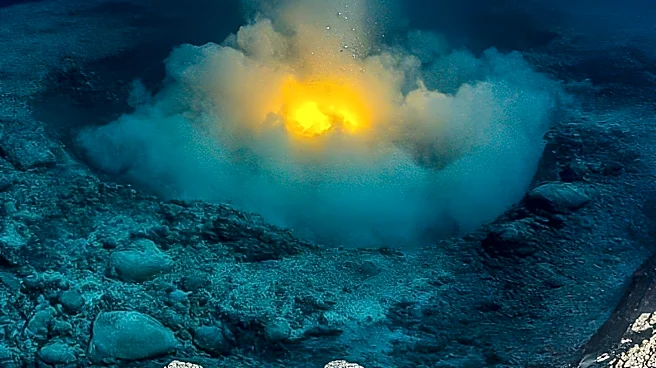
An underwater volcano named Northwest Eifuku, located in the Pacific Ocean within the Mariana Arc group of the Pacific Ring of Fire, has been observed emitting liquid carbon dioxide (CO2) from its seafloor. This phenomenon, known as the Champagne Vent,
was first discovered in 2004 by deep-sea scientists using a remotely operated vehicle (ROV). The CO2 spurts out like fizzing champagne, forming bubbles that are mostly liquid carbon dioxide combined with a small amount of hydrogen sulfide. These bubbles are under such high pressure that the CO2 is squished into a liquid, held together by a skin of carbon dioxide hydrate. The bubbles rise because they are less dense than the surrounding seawater at that depth. This is a rare occurrence, with only a handful of such vents known globally, including the Okinawa Trough, Horseshoe edifice, and Toto Caldera.
Why It's Important?
The discovery and ongoing study of the Champagne Vent at Northwest Eifuku are crucial for understanding the potential impacts of human-induced carbon dioxide emissions on marine life and ocean chemistry. The high carbon content and increased acidity of the water around the vent provide a natural laboratory to observe how marine ecosystems respond to conditions similar to those predicted under ocean acidification scenarios. While no animals were found directly at the effervescent vent, thick mats of microbes and bacteria thrive there, forming the base of a food web that supports mussels, shrimps, crabs, and limpets in the surrounding areas. The rapid dissolution of mussel shells in this acidic environment offers insights into how rising ocean acidity could affect calcifying organisms globally, impacting marine biodiversity and the fishing industry.
What's Next?
Scientists will continue to monitor the Champagne Vent at Northwest Eifuku to gather more data on the long-term effects of high CO2 concentrations on marine ecosystems. Further research will likely focus on the unique microbial communities that thrive in these extreme conditions and how they contribute to the broader marine food web. The insights gained from this natural laboratory will be vital for refining climate models and predicting the future health of the oceans as atmospheric CO2 levels continue to rise. Understanding the mechanisms of CO2 release and its interaction with seawater at such depths could also inform strategies for carbon capture and storage, although direct applications are still far off. The ongoing exploration of other underwater volcanoes in the Pacific Ring of Fire may reveal more such vents, expanding our knowledge of deep-sea geological and biological processes.
Beyond the Headlines
The Champagne Vent represents a fascinating intersection of geology, chemistry, and biology, offering a glimpse into the Earth's dynamic processes and their profound influence on life. The existence of liquid CO2 at these depths challenges conventional understanding of gas behavior under extreme pressure and temperature. The unique ecosystem supported by chemosynthesis, rather than photosynthesis, highlights the adaptability of life and the diverse energy sources available in deep-sea environments. This discovery also underscores the vastness and mystery of the ocean, with much remaining to be explored and understood. The ethical implications of human activities on global ocean chemistry are brought into sharp focus by these natural phenomena, urging a deeper consideration of environmental stewardship and sustainable practices to protect these fragile and vital ecosystems.