



What's Happening?
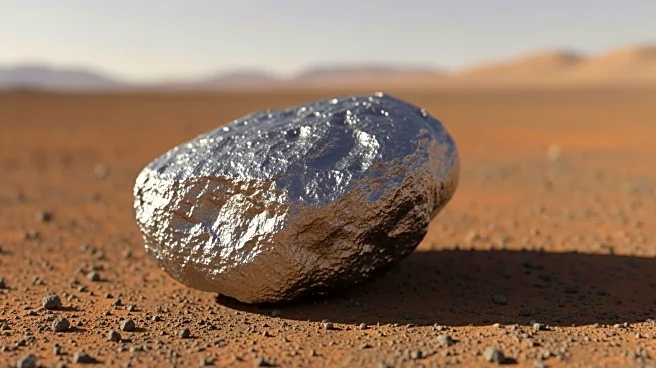
NASA's Perseverance rover has made a significant discovery on Mars by identifying a meteorite in the Jezero Crater. This marks the first time Perseverance has found a meteorite since its landing in February 2021. The meteorite, named Phippsaksla, contains
high levels of iron and nickel, suggesting it may have originated from the core of large asteroids elsewhere in the solar system. This discovery is crucial for understanding Mars' geological history and its interactions with space objects. Meteorites like Phippsaksla can provide insights into the materials present in the early solar system and the effects of impacts on Mars. The preserved condition of meteorites on Mars, due to the lack of a protective atmosphere, allows scientists to study them over long periods.
Why It's Important?
The discovery of the Phippsaksla meteorite is significant as it offers a window into Mars' past and its potential to preserve traces from the broader solar system. Meteorites can contain materials dating back to before the formation of the solar system, making them valuable for studying ancient conditions. Understanding Mars' interactions with meteorites can help scientists test theories about erosion resistance and the planet's ability to preserve cosmic debris. This finding contributes to the broader mission of Perseverance, which aims to collect samples from the Jezero Crater to find signs of ancient life and understand Mars' climate and environment.
What's Next?
NASA will continue to analyze the Phippsaksla meteorite to confirm its status and further understand its composition. The ongoing mission of Perseverance involves collecting samples from the Jezero Crater, which may offer more context about Mars' ancient environment. The rover's findings will contribute to the study of Mars' potential for life-supporting conditions and its geological history. Future discoveries by Perseverance could provide additional insights into the planet's interactions with space objects and its capacity to preserve remnants of cosmic debris.