








What's Happening?
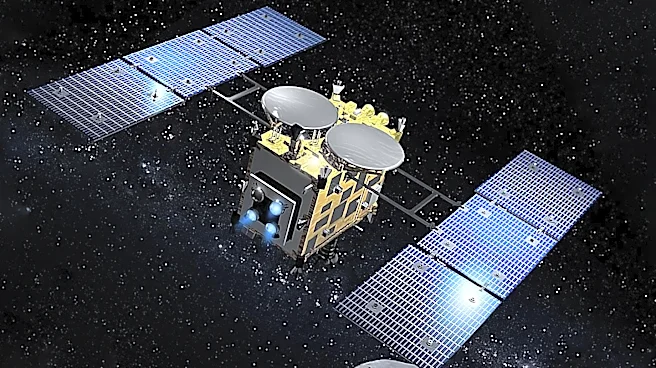
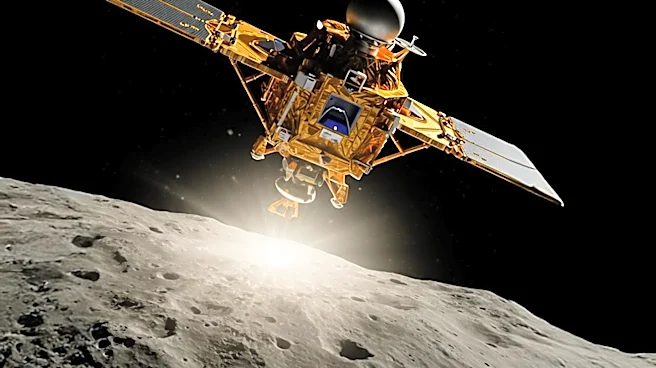
China's Tianwen-2 spacecraft has successfully reached the quasi-moon Kamo'oalewa, returning the first close-up image of the small asteroid. The image, taken from about 20 kilometers away, shows an uneven, angular body. This mission marks China's first asteroid sample-return
endeavor, with plans to return material to Earth by 2027. The spacecraft's journey involved a 400-day pursuit covering approximately 1 billion kilometers. New evidence has emerged challenging the theory that Kamo'oalewa is a fragment from the Moon, suggesting alternative origins.
Why It's Important?
The Tianwen-2 mission represents a significant advancement in China's space exploration capabilities, contributing to the global understanding of near-Earth objects. The study of Kamo'oalewa could provide insights into the formation and evolution of asteroids, as well as the history of the solar system. The mission's findings may also influence theories about the origins of quasi-moons and their potential connections to lunar or asteroid material.
What's Next?
The Tianwen-2 spacecraft will continue to survey Kamo'oalewa's shape, composition, and internal structure. The mission team is preparing for sample collection, with the goal of returning the material to Earth for detailed analysis. This analysis will help determine the asteroid's origin and composition, potentially resolving debates about its lunar or asteroid origins. The spacecraft will then proceed to study the main-belt object 311P/PanSTARRS.