


What's Happening?
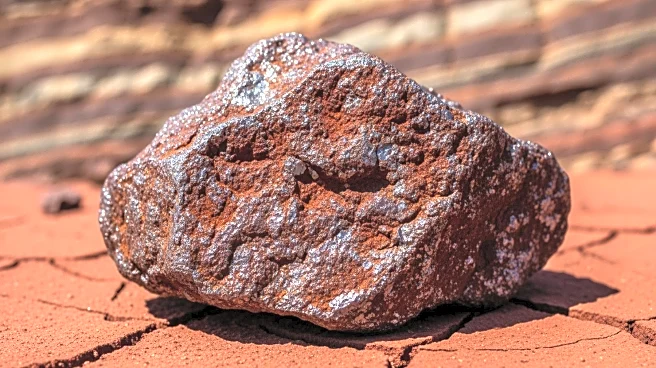
A recent geological study has uncovered a massive iron ore deposit in northwestern Australia, prompting a reevaluation of Earth's geological history. The discovery, located in the Hamersley Basin, suggests that the iron ore bodies formed between 1.4 and
1.1 billion years ago, which is significantly later than the previously believed timeframe of 2.2 to 2.0 billion years ago during the Great Oxidation Event. This finding challenges existing models that linked ore formation to early atmospheric changes. Instead, the new evidence points to tectonic activity associated with the breakup of the ancient Columbia supercontinent as the driving force behind the mineralization. The study, published in the Proceedings of the National Academy of Sciences, utilized in situ U-Pb isotopic dating on hematite samples, marking a methodological shift from previous approaches.
Why It's Important?
The discovery has significant implications for the understanding of Earth's geological history and the processes that lead to mineral formation. By linking ore formation to tectonic processes rather than atmospheric changes, the study provides a new framework for mineral exploration. This could influence exploration strategies in other regions with similar geological histories, such as South Africa, Canada, and Brazil. Economically, the deposit is estimated to contain 55 billion metric tonnes of ore, valued at over $5.7 trillion, reinforcing Australia's position as a leading iron ore exporter. The findings also highlight the potential for discovering similar deposits in other parts of the world, which could have far-reaching impacts on global trade and resource distribution.
What's Next?
Future research will likely focus on understanding the crustal thermal evolution and the drivers of fluid flow and structural deformation responsible for the upgrading of iron-rich sediments. The techniques used in this study may be applied to re-examine other large ore provinces with unclear origins. This could lead to further revisions of geological timelines and a better understanding of the interplay between tectonics and resource distribution. The discovery also opens up new questions about the role of deep-time tectonics in shaping modern mineral systems.