



What's Happening?
South Korea has been shipping significant quantities of fuel, primarily diesel, to Russian ports, with over 176,000 tonnes loaded onto tankers in July and August. This trade includes vessels sanctioned by the UK and EU, and some shipments involved ship-to-ship
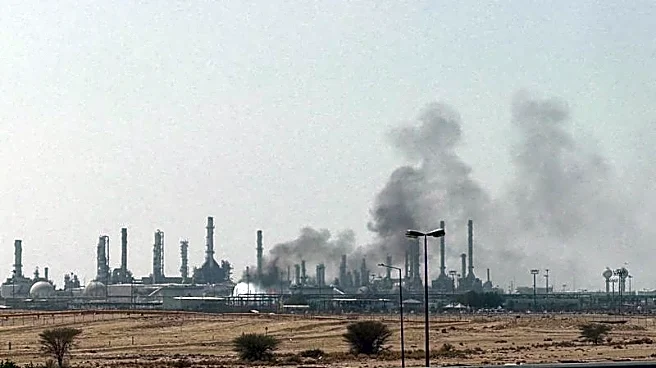
transfers in South Korean waters, a method that can obscure the origin of cargo. While South Korea has publicly supported Ukraine with humanitarian aid and non-lethal military supplies, and pledged $2.3 billion in support, these fuel shipments do not appear to violate South Korean law, which focuses on export controls for industrial machinery, electronics, and vehicles. The largest carrier, the sanctioned Layla, made two voyages from Ulsan to Vladivostok, carrying 57,000 tonnes of diesel. Another sanctioned tanker, the Russian-flagged Astoria, loaded nearly 11,000 tonnes of fuel at Ulsan before sailing to Vladivostok. A third sanctioned tanker, the Chongchon, took on approximately 26,000 tonnes of fuel via ship-to-ship transfer off Yeosu and then headed to Vladivostok. This activity comes as Russia's oil refining capacity has been severely impacted by Ukrainian drone strikes, leading to increased fuel imports.
Why It's Important?
The fuel shipments from South Korea to Russia are significant because they raise questions about the effectiveness of international sanctions against Russia and potentially undermine South Korea's stated support for Ukraine. The use of sanctioned tankers and ship-to-ship transfers suggests an effort to circumvent existing restrictions, which could weaken the collective pressure exerted by Western allies on Russia. For the U.S. and its allies, this situation highlights a potential loophole in the sanctions regime and could lead to diplomatic discussions regarding enforcement and compliance. The fact that South Korean law does not prohibit these specific shipments, despite some vessels being under UK and EU sanctions, indicates a divergence in legal frameworks among allied nations. This could complicate efforts to present a united front against Russia's actions in Ukraine and may prompt a review of how sanctions are applied and enforced globally. Furthermore, Russia's reliance on imported fuel due to damaged refining capabilities underscores the impact of the conflict on its energy sector, making any external supply crucial for its war efforts.
What's Next?
The revelation of these fuel shipments is likely to prompt increased scrutiny from international bodies and allied nations, particularly the UK and EU, whose sanctioned vessels were involved. There may be calls for South Korea to align its domestic laws more closely with international sanctions to prevent such circumvention in the future. Diplomatic pressure could be applied to Seoul to clarify its stance on trade with Russia and to ensure its actions do not inadvertently support Russia's military operations. The U.S. may engage in bilateral discussions with South Korea to address these concerns and reinforce the importance of a unified approach to sanctions. Additionally, there could be investigations into the ownership and sale of the fuel to determine if any entities are deliberately exploiting legal ambiguities. The ongoing monitoring of port records and ship-tracking data will likely continue to expose similar activities, potentially leading to further adjustments in sanctions policies and enforcement strategies by the international community.
Beyond the Headlines
The situation extends beyond immediate sanctions compliance, touching upon the complex geopolitical balancing act South Korea maintains. While publicly supporting Ukraine, Seoul also seeks to improve ties with Russia and has a policy of not supplying lethal arms to countries at war. This dual approach reflects South Korea's economic interests and its strategic position in a region with its own security challenges, including North Korea. The fuel trade, even if not illegal under South Korean law, could be perceived as a moral or ethical compromise by some international observers, potentially straining relationships with key Western partners. It also highlights the broader challenge of enforcing sanctions in a globalized economy where supply chains are intricate and legal interpretations can vary. The incident could trigger a re-evaluation of how nations define and implement their foreign policy objectives, especially when economic pragmatism intersects with international humanitarian and security concerns. This could lead to a more nuanced understanding of 'support' in international conflicts and the practical limitations of multilateral sanctions.