







What's Happening?
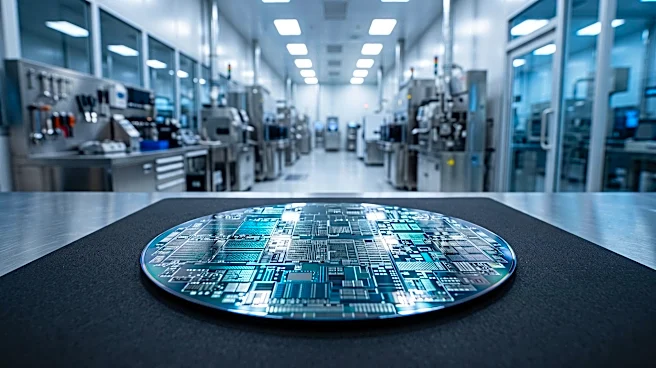
The U.S. has enacted the CHIPS and Science Act of 2022, a significant initiative designed to bolster domestic semiconductor manufacturing. This legislation seeks to decrease the nation's reliance on foreign supply chains, particularly from China, and enhance
the security of critical technology components. The Act provides incentives and support for semiconductor companies to establish and expand manufacturing facilities within the United States. Concurrently, India has launched its Semicon India Programme, which aligns with U.S. goals by offering incentives to attract global semiconductor firms and build its own domestic chip manufacturing capabilities. Both countries are collaborating on technology transfer, joint research and development, and investments to strengthen their respective semiconductor ecosystems. U.S. firms like Micron, AMD, and Applied Materials are partnering with India to develop its chip manufacturing infrastructure, with Micron investing $2.75 billion in a semiconductor assembly and test plant in Gujarat.
Why It's Important?
The CHIPS Act is crucial for U.S. national security and economic competitiveness. By incentivizing domestic production, the U.S. aims to mitigate risks associated with geopolitical tensions and supply chain disruptions, which have previously impacted various industries. A robust domestic semiconductor industry ensures a more reliable supply of essential chips for defense, technology, and consumer electronics. The collaboration with India further diversifies the global semiconductor supply chain, reducing over-reliance on any single region. This strategic partnership also fosters technological advancements through joint R&D and knowledge transfer, potentially leading to innovations in next-generation semiconductor materials. For U.S. companies, investing in India provides access to new markets and manufacturing capabilities, while for India, it accelerates its goal of becoming a major chip manufacturing hub, creating jobs and fostering economic growth.
What's Next?
The U.S. will continue to implement the CHIPS Act, allocating funds and support to domestic semiconductor projects. This will likely lead to the establishment of new fabrication plants and the expansion of existing ones across the country. Further collaborations between U.S. and Indian entities are expected, focusing on technology transfer, joint ventures, and policy alignment to streamline export controls and facilitate technology sharing. The Indo-Pacific Economic Framework (IPEF) and the Quad Semiconductor Partnership, involving the U.S., Japan, and Australia, will continue to play a role in integrating India into the global chip supply network, particularly in packaging, testing, and fabrication of mature nodes. The long-term success will depend on addressing challenges such as skilled workforce shortages, ensuring stable power and water supplies, and maintaining a business-friendly regulatory environment.
Beyond the Headlines
The push for domestic semiconductor manufacturing extends beyond immediate economic and security concerns, touching upon broader geopolitical strategies. Reducing dependency on foreign chip production is a critical step in safeguarding technological sovereignty and maintaining a competitive edge in emerging technologies like AI, quantum computing, and 5G/6G. This initiative also highlights a global trend towards regionalizing critical supply chains, driven by lessons learned from recent global disruptions. The ethical implications involve ensuring fair labor practices and environmental sustainability in new manufacturing facilities. Legally, the framework for international technology transfer and intellectual property protection will need continuous refinement. Culturally, this shift could foster a renewed emphasis on STEM education and advanced manufacturing skills within the U.S. workforce, shaping future generations' career paths and national innovation capacity.