

What's Happening?
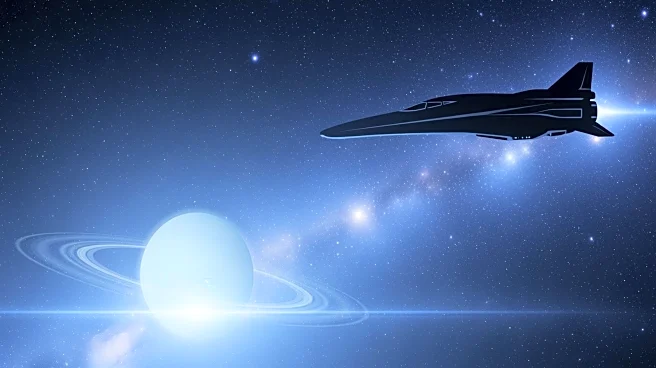
NASA's Voyager 2 probe, which conducted a flyby of Uranus in 1986, has been the subject of renewed scientific interest due to a recent study by the Southwest Research Institute (SwRI). The study reanalyzed data from the probe, which originally recorded
an unexpectedly high-energy electron belt around Uranus. Scientists now hypothesize that these observations were influenced by a transient solar wind event, known as a 'co-rotating interaction region,' that coincided with the flyby. This event may have produced powerful high-frequency waves, which were initially thought to scatter electrons into Uranus' atmosphere. However, it is now believed that these waves could have accelerated electrons, adding energy to the system. The study, led by Dr. Robert C. Allen and his team, draws parallels between these findings and similar solar wind interactions observed on Earth.
Why It's Important?
The reanalysis of Voyager 2's data provides new insights into the complex interactions between solar wind and planetary magnetospheres, particularly in the context of Uranus. Understanding these interactions is crucial for comprehending the dynamics of radiation belts, which have implications for space weather and planetary science. The findings suggest that Uranus' radiation environment is more dynamic than previously thought, potentially affecting future missions to the planet. This research also highlights the need for further exploration of Uranus and similar systems, such as Neptune, to better understand the fundamental physics of solar wind interactions. The study underscores the importance of revisiting historical data with modern scientific techniques to uncover new information.
What's Next?
The study's findings advocate for a dedicated mission to Uranus to further investigate its radiation environment and magnetosphere. Such a mission could provide more detailed measurements and help answer outstanding questions about the planet's unique characteristics. Additionally, the research may influence the design of future space missions by highlighting the need to account for transient solar wind events when studying planetary systems. The scientific community may also explore similar phenomena in other planetary systems, broadening our understanding of solar wind interactions across the solar system.