


What's Happening?
L3Harris Technologies has been awarded a multiyear contract by the U.S. Marine Corps and U.S. Navy to supply 34 T7 robots designed for explosive ordnance disposal (EOD) missions. The contract, announced recently, will see the delivery of these robots within
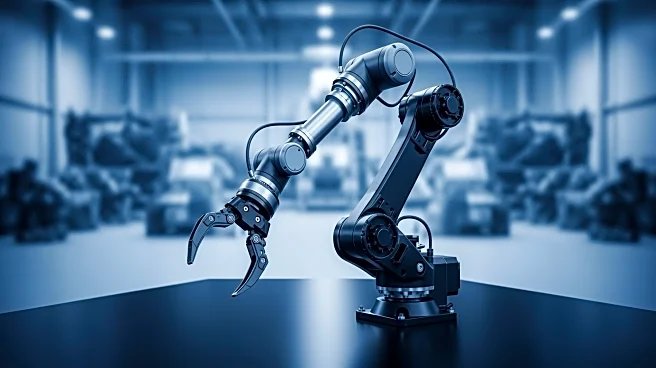
the year. The T7 robots are known for their advanced capabilities, including a highly maneuverable arm capable of lifting nearly 300 pounds, multicamera views, and the ability to operate in confined spaces and climb stairs. These features make them particularly suited for complex EOD tasks. The robots also provide haptic feedback, allowing operators to handle dangerous materials with precision from a safe distance. This contract follows a previous purchase by the U.S. Air Force in 2021, which acquired 170 T7 robots for similar purposes.
Why It's Important?
The acquisition of T7 robots by the U.S. Navy and Marine Corps underscores the increasing reliance on advanced robotics for military operations, particularly in hazardous environments. These robots enhance the safety and efficiency of EOD missions, reducing the risk to human personnel. The contract also highlights L3Harris Technologies' role as a key supplier of military technology, potentially strengthening its market position. For the U.S. military, the deployment of these robots represents a strategic investment in modernizing its capabilities to address evolving threats. The use of such technology could lead to broader adoption across other military branches and influence future procurement strategies.
What's Next?
Following the contract, L3Harris Technologies will provide comprehensive training to service personnel on the operation of the T7 robots. This training is crucial to ensure that military personnel can effectively utilize the robots' capabilities in real-world scenarios. As the robots are integrated into military operations, their performance and reliability will likely be closely monitored, potentially influencing future contracts and technological developments. Additionally, the success of this deployment could lead to further investments in robotic systems for other military applications, expanding the role of automation in defense strategies.