


What's Happening?
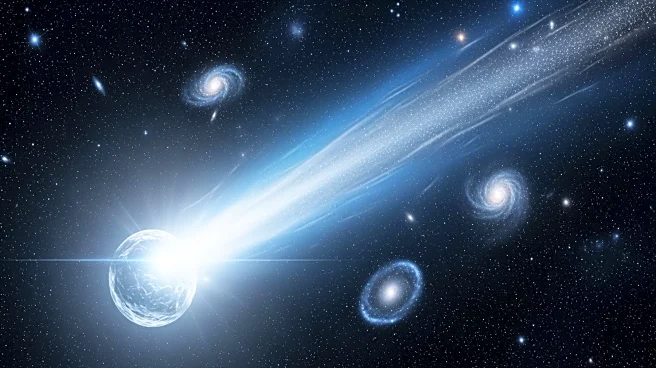
NASA's Hubble Space Telescope has captured new images of the interstellar comet 3I/ATLAS using its Wide Field Camera 3. The comet, first spotted in the summer of 2025, is only the third known interstellar object to pass through our solar system. The images reveal
the comet's trajectory and its hyperbolic path, indicating it is not bound by the Sun's gravity. The comet will not come closer than 170 million miles from Earth, posing no threat. These observations are part of ongoing efforts to study interstellar objects and their characteristics.
Why It's Important?
The observation of interstellar comet 3I/ATLAS provides valuable insights into objects originating from outside our solar system. Studying such comets helps scientists understand the composition and behavior of celestial bodies that are not influenced by the Sun's gravitational pull. This research can offer clues about the formation and evolution of other solar systems, contributing to our knowledge of the universe. The data collected by Hubble and other telescopes will enhance our understanding of interstellar phenomena and improve our ability to detect and study similar objects in the future.
What's Next?
NASA plans to continue observing the comet for several more months, utilizing its space telescopes to gather more data. These observations will help refine models of interstellar object behavior and improve detection techniques. The scientific community is likely to analyze the data to gain further insights into the comet's composition and trajectory. As technology advances, future missions may focus on capturing more detailed images and data from interstellar objects, potentially leading to new discoveries about the universe beyond our solar system.