



What's Happening?
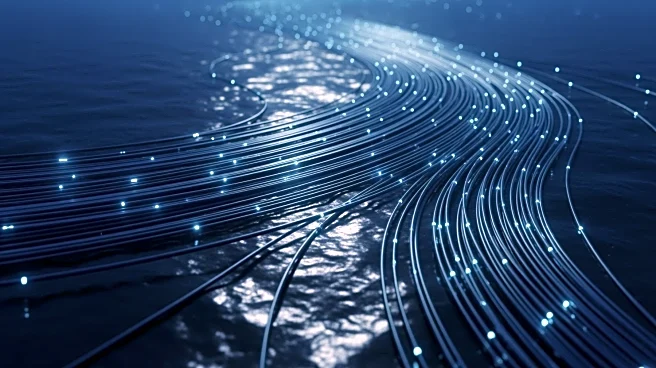
Subsea fiber-optic cables are responsible for carrying nearly all of the world's international internet traffic, according to a recent analysis. These undersea cables connect continents and are crucial for the global internet infrastructure, overshadowing
terrestrial cross-border routes. The major subsea routes, such as those between the US and Europe, and the US and Asia, account for a significant portion of global data flow. These cables support hundreds of terabits per second, far surpassing the capacity of land-based connections. The report highlights that even when all terrestrial cross-border routes are combined, they account for less than one percent of global internet traffic. This infrastructure is essential for hyperscale cloud and content platforms, which rely on these high-capacity routes to move vast amounts of data efficiently.
Why It's Important?
The dominance of subsea cables in global internet traffic underscores the critical role they play in the digital economy. These cables are the backbone of international data exchange, supporting everything from cloud computing to streaming services. The reliance on a few major routes highlights potential vulnerabilities in global connectivity, as disruptions to these cables could have widespread impacts. Additionally, the concentration of data flow through these routes reflects economic priorities over geographical proximity, as data is routed through major exchange points for cost and performance optimization. This infrastructure is vital for maintaining the efficiency and reliability of global internet services, impacting businesses, governments, and consumers worldwide.