






What's Happening?
NASA's Goddard Space Flight Center has honored the late British actor Sir Patrick Stewart, known for his roles as Captain Jean-Luc Picard in 'Star Trek: The Next Generation' and Professor Charles Xavier in 'X-Men,' by sharing an image of colliding galaxies
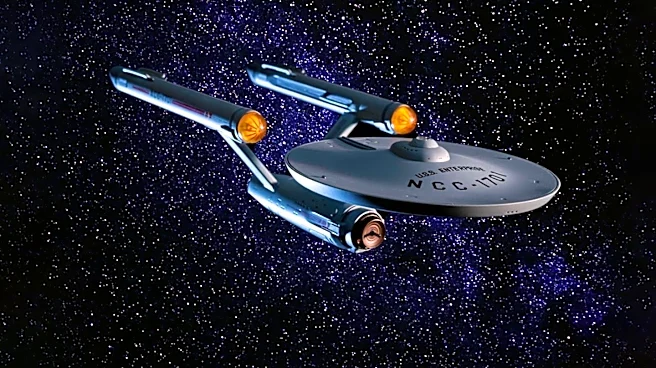
that resemble the USS Enterprise. Stewart passed away at 86 after a battle with Alzheimer's and Lewy Body Dementia. The image, captured by the Hubble Space Telescope, shows three galaxies collectively known as NGC 7764A. Two of these galaxies are interacting, forming the distinct shape of the USS Enterprise, with long trails of stars and gas extending from the collision. NASA Goddard posted on its X feed, "History will never forget the name Captain Picard. Thank you for inspiring the Next Generation of explorers," acknowledging Stewart's impact on science fiction and inspiration for future explorers. The interaction between galaxies occurs over vast periods, meaning this cosmic formation will remain stable for a long time.
Why It's Important?
This tribute from NASA highlights the significant cultural impact of science fiction, particularly 'Star Trek,' on public interest in space exploration and scientific endeavors. Sir Patrick Stewart's portrayal of Captain Picard inspired generations, including many who may have pursued careers in science and technology. The recognition by a prominent scientific institution like NASA underscores the role of popular culture in fostering curiosity and engagement with complex scientific concepts such as galaxy collisions and the vastness of space. It also demonstrates how scientific organizations can connect with the public through relatable cultural touchstones, bridging the gap between abstract scientific phenomena and human experience. The event serves as a reminder of the enduring legacy of figures who contribute to the imaginative landscape that often precedes and informs scientific progress.
What's Next?
While this specific event is a tribute, it reinforces a broader trend of scientific institutions engaging with popular culture to communicate their work and inspire new audiences. Future collaborations or acknowledgments between space agencies and entertainment figures or franchises are likely to continue, especially as space exploration becomes more prominent in public discourse. This approach can help maintain public interest and support for scientific research and missions. The image itself, NGC 7764A, will continue to be a subject of astronomical study, potentially revealing more about galaxy interactions and star formation processes. Astronomers will likely continue to observe such phenomena to refine models of galactic evolution and the universe's dynamic nature.
Beyond the Headlines
The intersection of science and popular culture, as exemplified by NASA's tribute, reveals a deeper societal appreciation for storytelling that explores humanity's place in the cosmos. 'Star Trek' has long been lauded for its optimistic vision of the future and its emphasis on exploration, diversity, and scientific advancement. This tribute suggests that the narratives we consume can profoundly influence our collective aspirations and even shape the direction of scientific inquiry. It also subtly highlights the human tendency to find familiar patterns and shapes in the vast, often abstract, cosmic landscape, making the universe more accessible and relatable. The enduring legacy of characters like Captain Picard extends beyond entertainment, serving as cultural touchstones that encourage critical thinking, ethical considerations, and a drive for discovery.