
What's Happening?
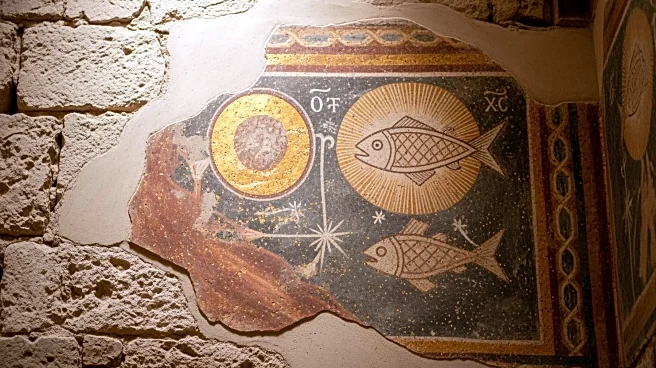
Archaeologists in Turkey have uncovered a rare fresco depicting Jesus as the 'Good Shepherd' in an underground tomb near Iznik, a site of significant historical importance for early Christianity. The fresco,
dating back to the third century, portrays a youthful, clean-shaven Jesus in Roman attire, carrying a goat on his shoulders. This discovery is considered one of the most important finds from Anatolia's early Christian era, as it represents a rare instance of Jesus being depicted with Roman attributes. The tomb, located in an area where the Nicene Creed was adopted in A.D. 325, offers insights into the period when Christians faced persecution under the Roman Empire. The fresco is hailed as one of Anatolia's best-preserved early Christian artworks.
Why It's Important?
The discovery of this fresco is significant as it provides a rare glimpse into early Christian art and the cultural exchanges between Roman and Christian traditions. It highlights the historical context of Christianity's development during a time of persecution and the blending of Roman artistic styles with Christian iconography. This find not only enriches the understanding of early Christian art but also underscores the historical importance of Iznik as a center for early Christian theological development. The fresco's preservation and the context of its discovery offer valuable insights into the religious and cultural dynamics of the time.