




What's Happening?
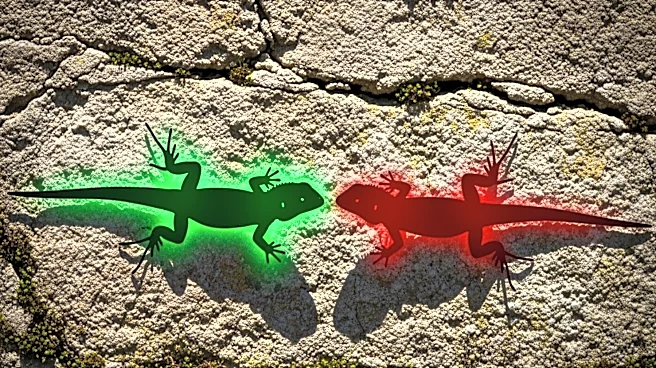
A study led by researchers at Lund University has revealed that aggressive 'Hulk' lizards are rapidly altering the evolutionary dynamics within the common wall lizard species, Podarcis muralis. Historically, these lizards exhibited a stable coexistence
of three distinct throat color morphs—white, yellow, and orange—across Mediterranean populations. This balance, which persisted for millions of years, is now being disrupted by the emergence of a dominant green morph known for its aggressive behavior. The study, published in Science, involved analyzing over 10,000 lizards from 240 populations. Findings indicate that the aggressive 'Hulk' lizards are causing the disappearance of yellow and orange morphs, leaving only the white morph in many areas. This rapid shift highlights the fragility of long-standing evolutionary systems and demonstrates how new traits can quickly reshape competition within a species.
Why It's Important?
The disruption caused by the 'Hulk' lizards underscores the potential for rapid evolutionary changes in response to new dominant traits. This phenomenon challenges the traditional view of evolution as a slow process, showing that significant shifts can occur swiftly when conditions change. The study provides insights into how aggressive behaviors can destabilize established social systems and alter species dynamics. Understanding these changes is crucial for conservation efforts, as it highlights the need to consider behavioral traits in managing biodiversity. The findings also contribute to broader discussions on how environmental and behavioral factors can drive evolutionary processes, offering valuable lessons for scientists studying other species facing similar challenges.