
What's Happening?
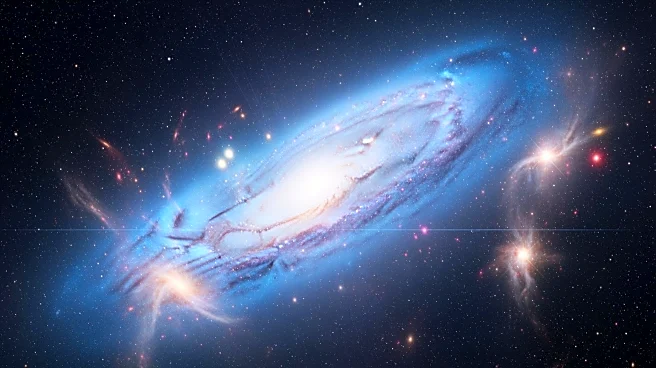
The XRISM spacecraft, a joint mission by JAXA and NASA, has made a groundbreaking measurement of the speed of gas erupting from the galaxy M82. The spacecraft's Resolve instrument captured X-ray emissions from superheated iron at the galaxy's core, revealing
wind speeds exceeding 3 million kilometers per hour. This discovery confirms that the hot inner wind is powerful enough to drive four solar masses of gas out of the galaxy annually. However, the measurements also highlight a discrepancy, as the galaxy expels enough material to form seven solar masses each year, leaving three solar masses unaccounted for. This finding challenges existing models and suggests that other mechanisms may be at play.
Why It's Important?
This discovery is significant for understanding the mechanics of starburst galaxies like M82, which form stars at a much faster rate than the Milky Way. The ability to measure such high-speed winds provides insights into how galaxies evolve and how star formation regulates itself. The findings also have implications for understanding the broader universe, as they offer clues about the role of galactic winds in shaping galaxies and their surrounding environments. The unaccounted solar masses present a new puzzle for astronomers, potentially leading to revisions in current models of galactic dynamics.
What's Next?
Future missions and models will need to address the discrepancy in the expelled solar masses. Researchers will likely focus on identifying the mechanisms responsible for the missing mass, whether it escapes the galaxy entirely or recirculates back into the galactic disk. The XRISM spacecraft's data will continue to be analyzed to refine our understanding of galactic winds and their impact on galaxy evolution. This ongoing research may lead to new insights into the life cycle of galaxies and the forces that drive their transformation.