
What's Happening?
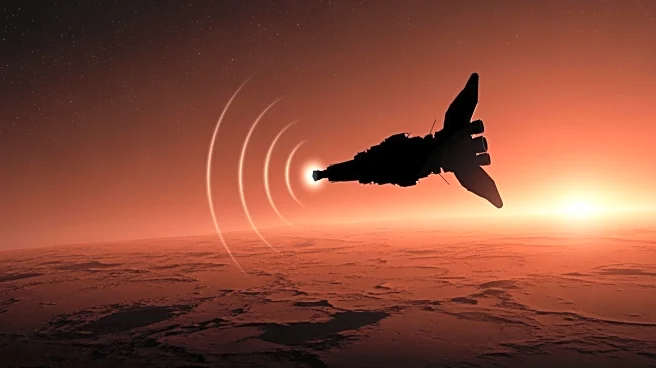
NASA's Mars Atmosphere and Volatile EvolutioN (MAVEN) spacecraft has lost communication with Earth after its orbit took it behind Mars on December 6th. The Deep Space Network has been unable to re-establish
contact with the orbiter, which was launched in November 2013. MAVEN is one of the newer Mars orbiters compared to the Mars Reconnaissance Orbiter and Mars Odyssey, which are significantly older. The European Space Agency's ExoMars, launched in 2016, could serve as a partial backup for MAVEN's communication relay functions, although its orbit is less ideal for large data transfers. The loss of MAVEN poses a challenge for ongoing and future Mars missions, as it plays a crucial role in relaying data from ground-based units, including active rovers.
Why It's Important?
The potential loss of MAVEN highlights the vulnerability of space missions to communication disruptions and the importance of having reliable backup systems. MAVEN's role in relaying data is critical for scientific research and the success of ground-based missions on Mars. Without it, data transfer capabilities are significantly hampered, affecting ongoing research and future exploration plans. The situation underscores the need for a replacement orbiter to ensure continuous communication support for Mars missions. The absence of a reliable relay could impact the planning and execution of future manned missions to Mars, as well as the ability to conduct comprehensive scientific studies.
What's Next?
NASA engineers are working to troubleshoot the communication issue with MAVEN, but options are limited without a signal from the spacecraft. Even if contact is restored, MAVEN's fuel reserves are limited, necessitating the development of a replacement orbiter. The Mars Telecommunications Orbiter, which was canceled in 2005, could be reconsidered as a potential solution. In the meantime, reliance on other orbiters like ExoMars may be necessary, although their capabilities are not fully aligned with MAVEN's functions. The situation may prompt discussions on the need for more robust and redundant communication systems for future Mars missions.