
What's Happening?
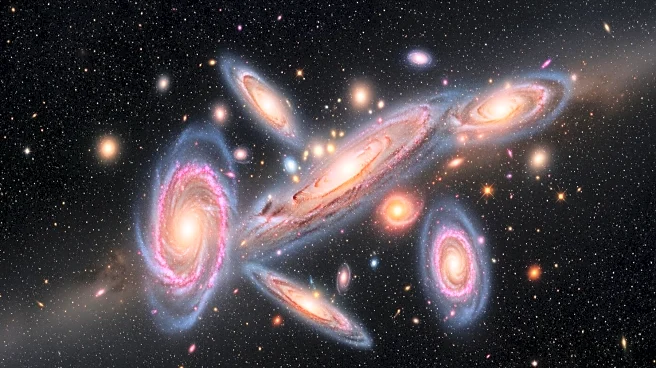
NASA's James Webb Space Telescope has captured a remarkable image of galaxies in the CEERS (Cosmic Evolution Early Release Science) field using its NIRCam instrument. The image is a composite of separate
exposures, each taken with different filters to cover a wide range of wavelengths. The colors in the image are assigned based on these filters, with blue representing F115W+F150W, green for F200W+F277W, and red for F356W+F444W. This method allows scientists to visualize the data in a way that highlights different features of the galaxies, providing insights into their composition and structure. The image is part of NASA's ongoing efforts to explore the universe and understand the formation and evolution of galaxies.
Why It's Important?
The James Webb Space Telescope's ability to capture detailed images of distant galaxies is crucial for advancing our understanding of the universe. By analyzing these images, scientists can study the formation and evolution of galaxies, which in turn helps to answer fundamental questions about the origins of the universe. The data collected by the telescope can also provide insights into the conditions that led to the formation of stars and planets, potentially offering clues about the possibility of life elsewhere in the universe. This research is vital for the scientific community and can influence future space exploration missions and technologies.
What's Next?
As NASA continues to analyze the data from the James Webb Space Telescope, further discoveries about the universe's early stages are expected. The telescope's findings will likely lead to new research projects and collaborations among scientists worldwide. Additionally, the insights gained from these images could inform the development of future telescopes and space missions, enhancing our ability to explore and understand the cosmos. The ongoing study of the CEERS field and other regions of space will remain a priority for NASA and the global scientific community.