




What's Happening?
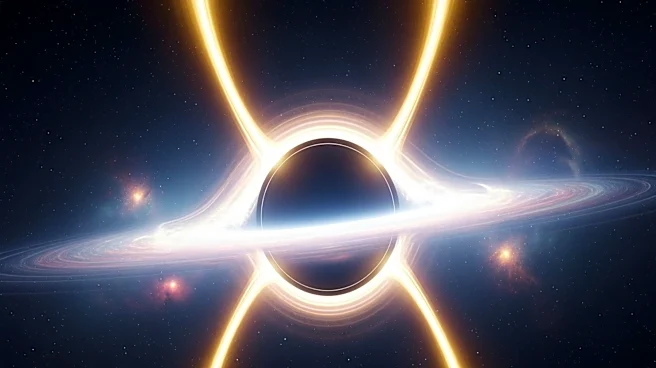
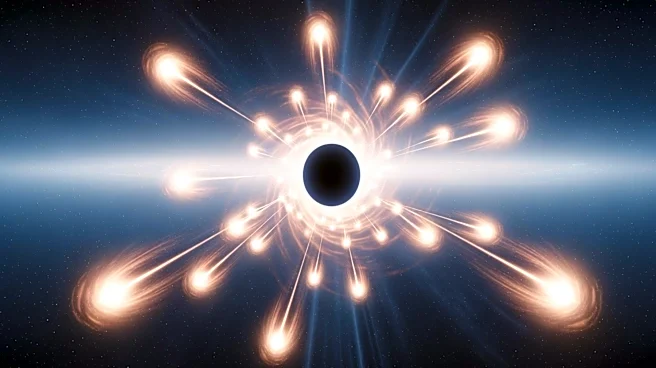
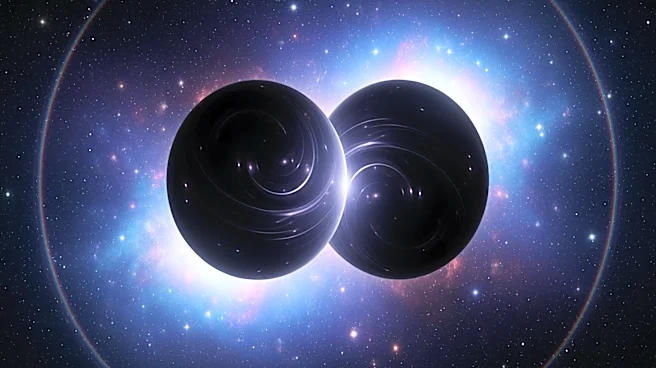
A new study has provided insights into the formation of the universe's largest black holes, suggesting they are created in dense star clusters through frequent violent collisions. Researchers analyzed 153 black hole mergers from the LIGO-Virgo-KAGRA Gravitational-Wave
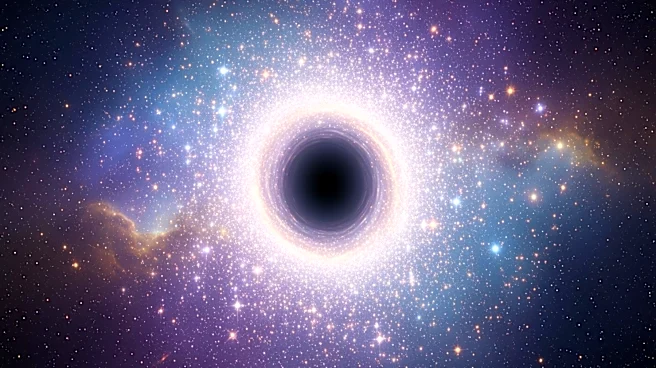
Transient Catalog, using gravitational wave detectors like LIGO, KAGRA, and Virgo. The study identified two black hole populations: a lower-mass group formed from collapsing massive stars and a higher-mass group formed through repeated mergers in dense star clusters. The latter group exhibited rapid, randomly oriented spins, supporting the theory that these black holes result from multiple mergers.
Why It's Important?
This research enhances our understanding of black hole formation and the dynamics within dense star clusters. It challenges existing models of stellar evolution and suggests that the largest black holes may not form directly from star collapse but through successive mergers. The findings also provide evidence for a 'mass gap' in black hole formation, where extremely massive stars may explode completely, leaving no black hole. This study could lead to revisions in the global understanding of black hole formation and the lifecycle of massive stars.
What's Next?
Further research will focus on refining models of stellar evolution and understanding the conditions that lead to black hole mergers in star clusters. Scientists aim to explore the implications of these findings for the broader cosmic environment and the evolution of galaxies. Continued observations with gravitational wave detectors will help identify more black hole mergers and refine theories about their origins.