



What's Happening?
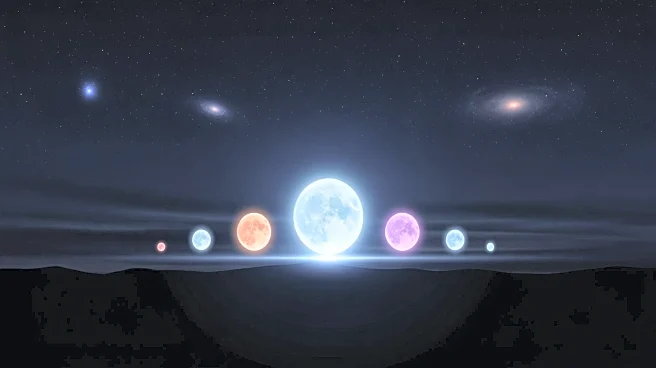
NASA has announced a rare celestial event where six planets—Mercury, Venus, Neptune, Saturn, Uranus, and Jupiter—will align in the evening sky, creating a 'planetary parade' visible shortly after sunset on February 28, 2026. This alignment is a unique
occurrence, as typically only two or three planets are visible together. The best viewing conditions will be towards the end of February, with four of the planets visible to the naked eye, while Uranus and Neptune will require binoculars or a telescope. Observers are advised to look westward about 30 minutes after sunset for the best experience. This event is significant as such alignments are rare, with the next similar occurrence expected in late October 2028.
Why It's Important?
The alignment of six planets offers a rare opportunity for both amateur and professional astronomers to observe a unique celestial event. Such occurrences can spark public interest in astronomy and science, potentially inspiring educational initiatives and increased funding for space exploration. The event also highlights the importance of clear skies and minimal light pollution for astronomical observations, which can influence public policy on environmental and urban planning. Additionally, the alignment serves as a reminder of the vastness and complexity of our solar system, encouraging a broader appreciation for space science.
What's Next?
Following this event, astronomers and enthusiasts will look forward to the next planetary alignment in October 2028, when five planets will be visible before sunrise. This anticipation can lead to increased public engagement with astronomy and related sciences. Educational institutions and observatories may plan events and workshops to capitalize on the public's interest, fostering a deeper understanding of celestial mechanics and the universe.