

What's Happening?
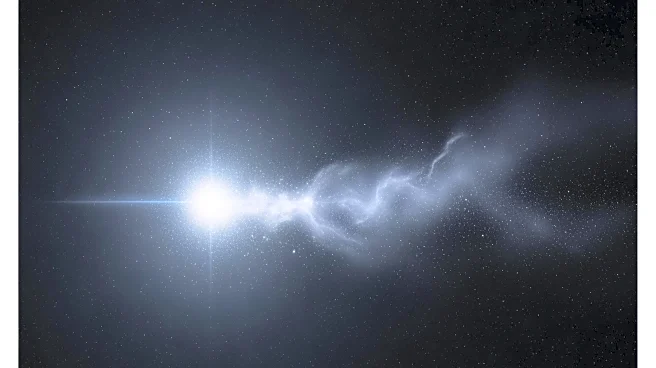
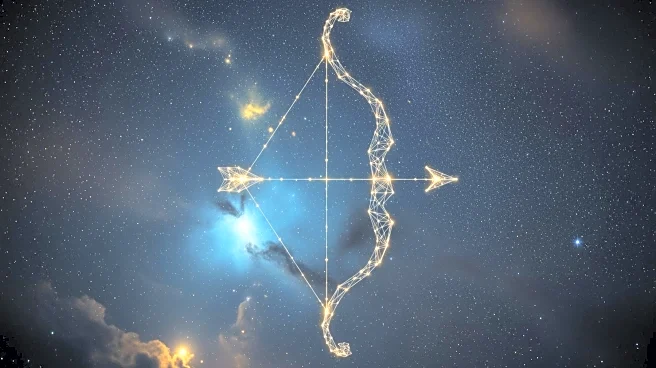
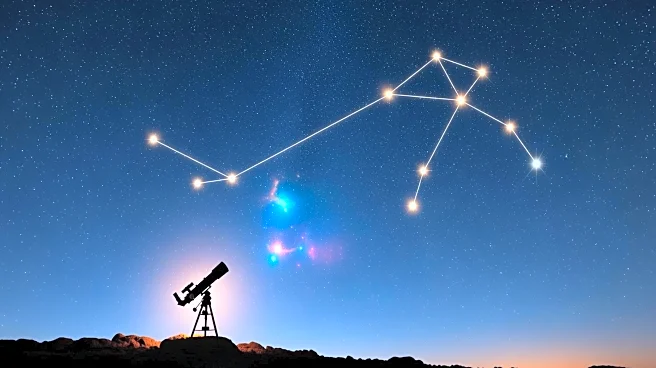
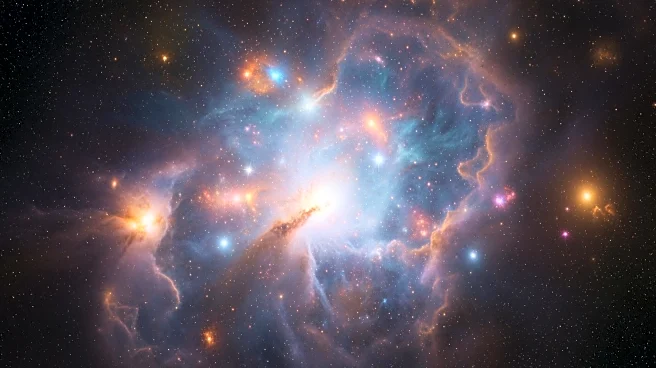
The James Webb Space Telescope (JWST) has captured new imagery of the Sagittarius B2 (Sgr B2) molecular cloud, the largest and most active star-forming region in the Milky Way. Located near the galaxy's center, Sgr B2 is a massive cloud of gas and dust,
home to young stars and dense regions of ionized hydrogen. JWST's infrared capabilities allow it to penetrate the dust and reveal details of the star formation process that were previously obscured. The images show the dense clouds that give birth to massive stars and suggest that a recent event, possibly a supernova shockwave, may have triggered the current star formation activity.
Why It's Important?
Understanding star formation in regions like Sgr B2 is crucial for comprehending the processes that shape galaxies. Massive stars have a significant impact on their environment, influencing the formation of other stars and the evolution of galaxies. The insights gained from JWST's observations of Sgr B2 can also inform studies of distant galaxies, providing a window into the conditions that prevailed in the early universe. This research helps astronomers piece together the history of star formation and the factors that drive it, contributing to a broader understanding of cosmic evolution.
What's Next?
The findings from Sgr B2 are expected to lead to further studies of massive star formation both within the Milky Way and in other galaxies. Astronomers will continue to analyze JWST's data to uncover more about the processes occurring in Sgr B2 and similar regions. These studies will enhance our knowledge of the lifecycle of stars and the dynamics of star-forming regions. As JWST continues to observe the universe, it will likely reveal more about the complex interactions that govern star formation and the development of galaxies.