






What's Happening?
The smart home industry is moving towards comprehensive, anticipatory smart living through advanced AI integrations. This evolution is making homes more responsive and intelligent, proactively adjusting environments based on user needs. Key trends include
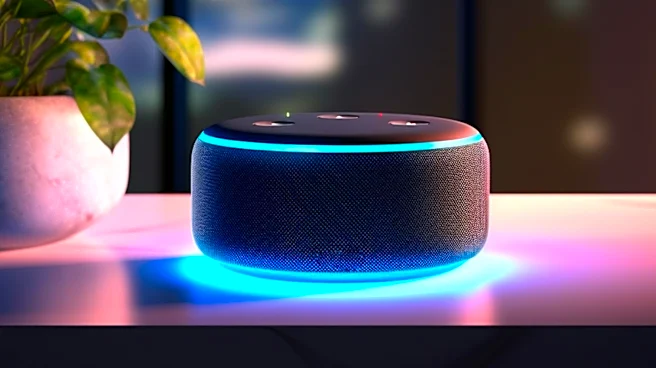
sophisticated voice-controlled AI, which is transitioning from simple commands to true conversational interactions, often powered by on-site neural processors to minimize latency and enhance privacy. Dynamic smart glass windows are also emerging, capable of instantly changing tint or frosting based on real-time weather data, sun angle, or privacy commands. Furthermore, security and automation technologies are advancing with reliable, low-power solutions for smart home hubs, security cameras, and door locks. These developments aim to create high-performance, virtually invisible, and immersive smart home experiences, moving beyond basic device control to a more integrated and intuitive living environment.
Why It's Important?
This shift in smart home technology holds significant importance for U.S. consumers and the technology industry. For consumers, it promises a new level of convenience and efficiency, transforming homes into adaptive spaces that anticipate needs, potentially leading to energy savings and enhanced comfort. The emphasis on on-site neural processors for AI command processing also addresses growing concerns about data privacy and security, as less data needs to be sent to cloud servers. For the U.S. technology sector, these advancements represent new market opportunities in hardware, software, and integration services. Companies developing AI, smart glass, and advanced security systems stand to gain, fostering innovation and competition. The integration of these technologies could also influence urban planning and residential construction, as smart home capabilities become a standard expectation rather than a luxury add-on, impacting real estate values and consumer demand.
What's Next?
Looking ahead, the smart home market is expected to see continued integration of AI and advanced sensor technologies. The development of more sophisticated voice assistants capable of conversational interactions will likely become a standard feature, alongside the wider adoption of dynamic smart glass for enhanced energy efficiency and privacy. Further advancements in security, such as biometric authentication and AI-driven video analytics, will likely become more prevalent, offering robust boundary defense. The industry will also focus on creating more seamless and invisible technology, where devices blend into the home environment. As these technologies mature, there will be an increased demand for skilled integrators and developers to customize and maintain these complex systems. The focus will also be on ensuring interoperability between different smart home devices and platforms, moving towards a more unified and user-friendly ecosystem.
Beyond the Headlines
The deeper implications of these smart home advancements extend to ethical considerations regarding privacy and autonomy. While on-site AI processing aims to enhance privacy, the sheer volume of data collected by an anticipatory smart home raises questions about data ownership and potential misuse. The increasing reliance on AI to manage daily routines could also subtly influence human behavior and decision-making, potentially leading to a decrease in personal agency. Culturally, these technologies could redefine the concept of 'home' itself, transforming it from a static dwelling into a dynamic, responsive entity. Legally, new frameworks may be required to address issues such as data breaches in smart home ecosystems and the liability for automated system failures. The long-term societal impact could include a widening digital divide, as access to these advanced, often luxury, technologies may remain exclusive to higher-income demographics, further entrenching inequalities.