






What's Happening?
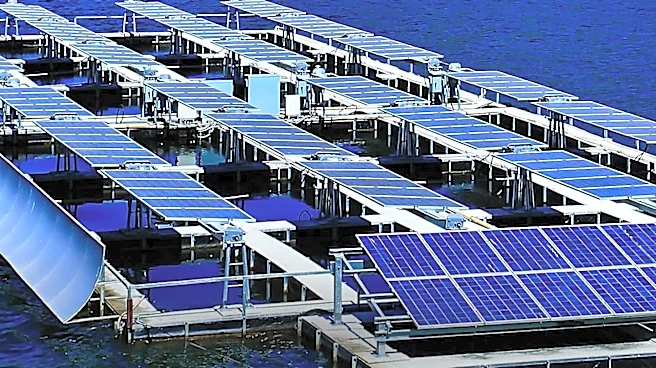
The Union Cabinet has approved the Pradhan Mantri Surya Sarovar Yojana (PM-SSY), a significant initiative aimed at enhancing India's renewable energy capacity through the development of 5,000 MW of floating solar photovoltaic (FSPV) systems on reservoirs
and water bodies. This scheme, with a financial outlay of ₹5,070 crore, includes Central Financial Assistance of up to ₹1 crore per MW, which will be disbursed post-commissioning of the plants. The initiative mandates the integration of energy storage systems to ensure power availability during peak demand periods. The Solar Energy Corporation of India (SECI) will oversee the implementation, with expectations of attracting ₹28,500 crore in investments. Currently, India's floating solar capacity is approximately 0.7 GW, with a potential of 102 GW.
Why It's Important?
This initiative is crucial for India's renewable energy strategy, addressing the land scarcity issue that hampers ground-mounted solar projects. By utilizing water surfaces, the scheme not only expands solar capacity but also decentralizes energy production, particularly in states with large reservoirs but limited renewable resources. The mandatory energy storage component is expected to mitigate the curtailment problem, where solar output is reduced to maintain grid stability. This development aligns with India's climate commitments, contributing to the country's goals of achieving 500 GW of non-fossil power by 2030 and net-zero emissions by 2070. The scheme is projected to reduce CO2 emissions by 10 million tonnes annually and create significant employment opportunities.
What's Next?
The next steps involve detailed feasibility studies funded by the government to assess the ecological impact and solar yield potential of proposed sites. These studies aim to lower the entry barrier for state governments to propose projects. The implementation will require adaptive mooring designs to handle water level fluctuations, ensuring the stability of the solar arrays. As the scheme progresses, it is expected to stimulate further investment in renewable energy infrastructure and technology, potentially positioning India as a leader in floating solar technology.
Beyond the Headlines
The floating solar initiative represents a shift towards innovative solutions in renewable energy, addressing both environmental and logistical challenges. By reducing land use conflicts and enhancing energy storage capabilities, the scheme could serve as a model for other countries facing similar constraints. The integration of battery storage not only stabilizes the grid but also enhances the reliability of solar power, making it a more viable alternative to traditional energy sources. This development could also spur advancements in related technologies, such as energy storage and water management systems.