
What's Happening?
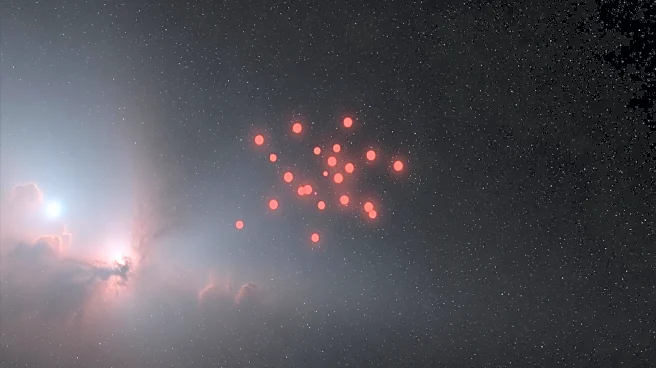
Scientists have potentially solved the mystery of 'little red dots' (LRDs) observed by the James Webb Space Telescope. Initially spotted in December 2022, these LRDs puzzled astronomers due to their unexpected
characteristics. Recent research suggests that these dots are young supermassive black holes concealed by a cocoon of gas, which they consume to grow larger. This gas cocoon disguises the black holes, preventing the emission of typical X-rays and radio waves. The findings, published in the journal Nature, provide new insights into the early universe and the formation of supermassive black holes.
Why It's Important?
The discovery of the true nature of the 'little red dots' offers significant implications for our understanding of the universe's evolution. By identifying these LRDs as young supermassive black holes, scientists can refine models of cosmic development and the role of black holes in galaxy formation. This research challenges existing theories and highlights the complexity of the early universe. The findings also demonstrate the capabilities of the James Webb Space Telescope in uncovering new cosmic phenomena, reinforcing its role as a critical tool for astronomical research.
Beyond the Headlines
The identification of LRDs as young supermassive black holes challenges traditional views of cosmic evolution, where young stars are typically associated with blue colors. This discovery suggests that the universe's early stages may have been more dynamic and varied than previously thought. The research also underscores the importance of advanced telescopes like the James Webb in exploring the universe's mysteries, potentially leading to further breakthroughs in our understanding of space and time.