


What's Happening?
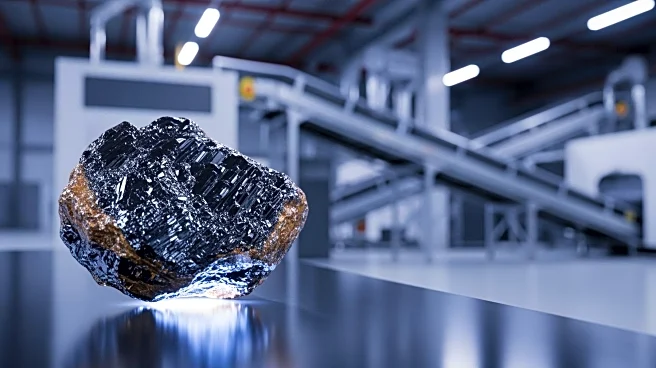
President Trump has announced the launch of a $12 billion strategic minerals stockpile aimed at bolstering U.S. manufacturing and countering China's influence in the critical minerals market. The initiative, known as Project Vault, will be funded by a $10
billion loan from the U.S. Export-Import Bank, with additional private investment. The stockpile will include essential minerals such as lithium, nickel, and rare earths, which are crucial for manufacturing electric vehicles and high-tech weaponry. The project aims to stabilize market prices and support domestic mining and refining efforts. The Ex-Im Bank's board is set to vote on authorizing the loan, and President Trump is scheduled to meet with industry leaders to discuss the initiative.
Why It's Important?
The establishment of a strategic minerals stockpile is a significant move to enhance U.S. manufacturing capabilities and reduce reliance on foreign sources, particularly China, for critical minerals. By securing a stable supply of these materials, the U.S. aims to strengthen its industrial base and support key sectors such as automotive and technology. The initiative also seeks to mitigate the risks associated with volatile mineral prices and supply chain disruptions. This move could encourage further investment in domestic mining and refining, potentially leading to job creation and economic growth. Additionally, it reflects a broader strategy to enhance national security by ensuring access to essential resources.
What's Next?
Following the Ex-Im Bank's vote, the project will likely proceed with the procurement and stockpiling of critical minerals. The involvement of major commodities trading firms suggests that the logistics and management of the stockpile will be handled by experienced industry players. The initiative may also prompt legislative action, as a bipartisan group of lawmakers has introduced a bill to create a separate $2.5 billion stockpile. As the project develops, it will be important to monitor its impact on domestic mining and manufacturing, as well as its effectiveness in countering China's market influence.