


What's Happening?
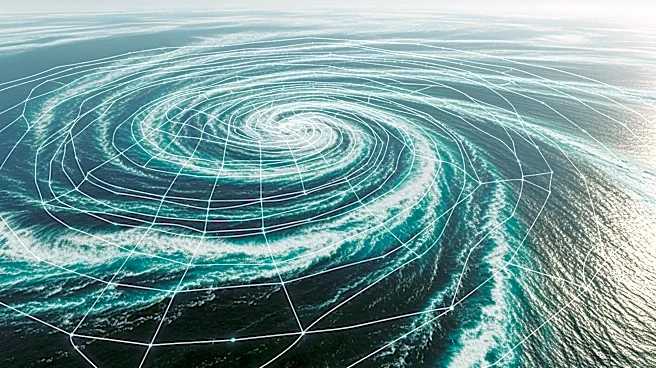
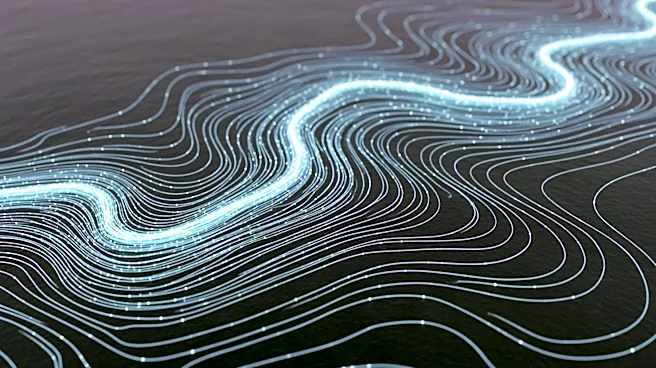
Researchers at the University of California, San Diego have developed an AI tool named GOFlow that significantly enhances the mapping of ocean currents. This tool utilizes thermal imagery from weather satellites to track surface temperature changes, which
are influenced by underlying ocean currents. The AI-driven approach allows for more detailed and frequent observations of small, fast-changing ocean currents, which are crucial for understanding the movement of heat, carbon, nutrients, and pollutants in the ocean. The research, published in Nature Geoscience, demonstrates that GOFlow's outputs align with traditional methods but provide greater detail than previously possible. Despite its achievements, the tool faces limitations such as cloud cover obstructing satellite views, which researchers aim to address with additional satellite data.
Why It's Important?
The development of GOFlow represents a significant advancement in Earth observation technologies, which are vital for various stakeholders including governments, militaries, farmers, and insurance companies. By providing more detailed data on ocean currents, the tool can improve decision-making related to climate and environmental management. The integration of AI in this field exemplifies a broader trend where AI tools are enhancing data analysis speed and accuracy, potentially leading to more informed policy and business decisions. The ability to map ocean currents with greater precision can aid in climate change research and help mitigate environmental impacts.
What's Next?
Future work on GOFlow will focus on incorporating additional satellite data to overcome current limitations such as cloud cover. The researchers plan to make the computer code publicly available to facilitate further development and use by the broader scientific community. As AI continues to be integrated into Earth observation, it is expected that more routine use of large remote-sensing datasets combined with machine learning will become standard practice, potentially leading to new insights and applications in environmental science.