



What's Happening?
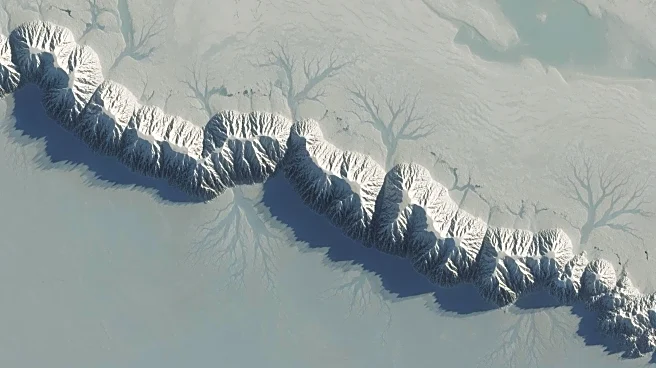
A Canadian satellite, RADARSAT, has discovered a hidden landscape beneath the Antarctic ice, dating back over 34 million years. This landscape, roughly the size of New Jersey, was revealed through subtle changes detected in the ice surface by technology
coordinated by Stewart Jamieson from Durham University. The discovery includes signs of an ancient riverbed and is considered a 'time capsule' of Earth's past, preserved since before the region became a frozen desert. This finding opens new avenues for scientific research, particularly in understanding how the ice sheet might respond to rising temperatures. The landscape's preservation offers insights into Earth's surface reactions to past climate changes.
Why It's Important?
The discovery is significant as it provides a rare glimpse into Earth's geological past, offering clues about how ancient terrains were shaped by river activity before the ice sheet formed. This information is crucial for understanding the dynamics of the East Antarctic Ice Sheet (EAIS) and its response to climate change. The findings could help scientists develop strategies to combat climate change by improving prediction models for ice sheet behavior and potential sea level rise. The research underscores the importance of monitoring Antarctica's ice sheets to better grasp the implications of a warming world.
What's Next?
The discovery is expected to lead to further studies on the impact of climate change on the Antarctic ice sheet. Scientists will likely focus on how the preserved landscape can inform predictions about future ice sheet responses to global warming. This could involve more detailed mapping of the subglacial terrain and modeling of past and future climate scenarios. The research may also prompt international collaboration to enhance understanding of polar regions and their role in global climate systems.
Beyond the Headlines
The discovery highlights the potential for technological advances, like RADARSAT, to uncover hidden geological features that can reshape our understanding of Earth's history. It also raises questions about the ethical implications of exploring and potentially exploiting these pristine environments. As climate change continues to pose a global threat, the findings emphasize the need for sustainable policies that protect vulnerable regions like Antarctica from further environmental degradation.