
What's Happening?
Christopher Doucet, a 68-year-old Canadian-born green card holder residing in the U.S. since childhood, has been indicted on a federal felony charge for falsely claiming U.S. citizenship to register and
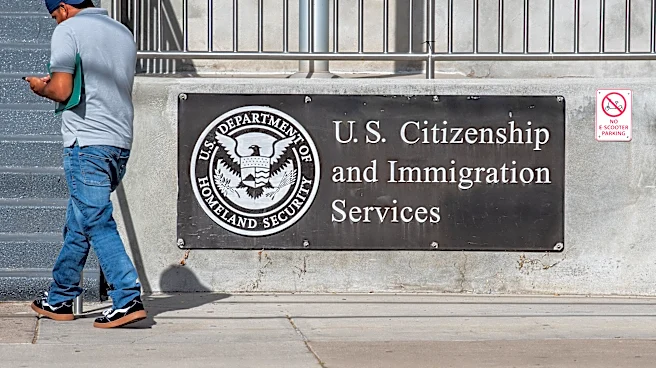
vote. The U.S. Attorney’s Office for the Western District of Missouri announced that Doucet registered in Jackson County, Missouri, on January 30, 2024, where he marked 'Yes' to the citizenship question and signed a certification affirming he was a U.S. citizen. Subsequently, on April 2, 2024, he cast a ballot in a general municipal election in Independence, Missouri, an election that did not include any federal offices. Doucet was arrested following the indictment by a federal grand jury. If convicted, he faces a potential sentence of up to five years in prison and a $250,000 fine. The investigation was conducted by Homeland Security Investigations with assistance from U.S. Citizenship and Immigration Services. An indictment serves as an accusation and does not constitute proof of guilt.
Why It's Important?
This case underscores the significant legal risks noncitizens face when participating in any U.S. election, regardless of whether federal offices are on the ballot. Many noncitizens mistakenly believe that voting violations are only federal crimes if they involve presidential or congressional elections. However, federal law (18 U.S.C. § 1015(f)) makes it a felony to knowingly claim U.S. citizenship to register or vote in any federal, state, or local election, including referendums and recalls. The crime is established by the false claim itself, even before a ballot is cast. Furthermore, state laws, such as Missouri's, impose additional penalties for ineligible registration. Beyond criminal charges, immigration law stipulates that noncitizens who vote unlawfully or falsely claim citizenship are deportable, often without the possibility of a waiver, and a criminal conviction is not required for these immigration consequences to apply. This case serves as a critical reminder for green card holders and other noncitizens to exercise extreme caution regarding voter registration and participation.
What's Next?
Following his arrest, Christopher Doucet will proceed through the federal judicial system, which typically involves an initial appearance, a decision on release or detention, arraignment, and either a plea agreement or a jury trial. Prosecutors will be required to prove that Doucet knowingly made the false claim of citizenship beyond a reasonable doubt. Separately, immigration proceedings could be initiated by the government at any point—before, during, or after the criminal case—as unlawful voting and false claims of citizenship are grounds for removal that do not require a criminal conviction. Under current USCIS policy, the agency is directed to issue a Notice to Appear in immigration court when it finds evidence of unlawful voting, unless a narrow exception applies. The outcome of the criminal trial, whether conviction or acquittal, will influence but not necessarily dictate the immigration consequences, as DHS can independently pursue removal based on the alleged false claim or unlawful vote.
Beyond the Headlines
The Doucet case highlights the complex and often unforgiving intersection of criminal and immigration law for noncitizens in the U.S. It brings to light the potential for severe, life-altering consequences stemming from actions in what might seem like a low-stakes local election. The case also draws attention to the nuances of voter registration forms, where a simple 'Yes' checkmark or even a signature under a citizenship oath can trigger federal felony charges and deportation proceedings. It emphasizes the critical importance for noncitizens to fully understand their rights and restrictions, particularly concerning civic participation. The case may also prompt increased scrutiny of voter registration processes and educational outreach to noncitizen communities regarding voting eligibility, aiming to prevent unintentional violations that carry such significant penalties. The broader implication is a reinforcement of the strict legal framework governing noncitizen participation in the U.S. electoral system.