


What's Happening?
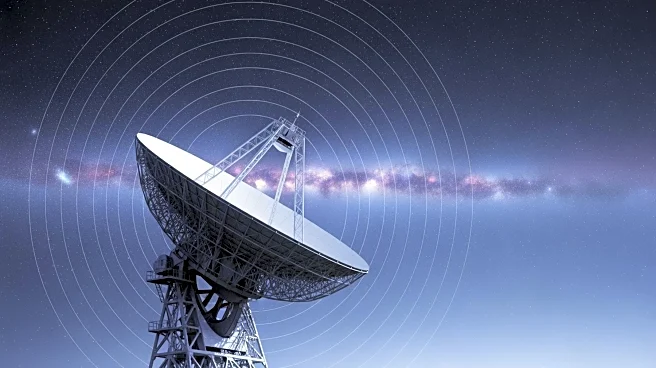
Astronomers at the International Centre of Radio Astronomy Research (ICRAR) have created the largest low-frequency radio image of the Milky Way, offering a new perspective on our galaxy. This image, developed by PhD student Silvia Mantovanini, was produced
using data from the Murchison Widefield Array (MWA) telescope in Western Australia. The project involved extensive computational work, utilizing approximately 1 million CPU hours on supercomputers to process data from the GaLactic and Extragalactic All-sky MWA (GLEAM) survey and its follow-up, GLEAM-X. The new image provides twice the resolution and ten times the sensitivity of previous images, allowing for a more detailed examination of the Milky Way. It highlights supernova remnants and stellar nurseries, offering insights into star formation and evolution.
Why It's Important?
This development is significant as it enhances the understanding of the Milky Way's structure and the lifecycle of stars. The improved resolution and sensitivity of the image allow astronomers to identify and study supernova remnants and stellar nurseries with greater clarity. This can lead to new discoveries about the formation and death of stars, as well as the distribution of pulsars within the galaxy. The image also sets a new benchmark for low-frequency radio astronomy, paving the way for future research with even more advanced telescopes like the SKA-Low telescope, which is expected to surpass this image in sensitivity and resolution.
What's Next?
The completion of the SKA-Low telescope in the next decade is anticipated to further advance the study of the Milky Way by providing even more detailed images. This will enable astronomers to explore large astrophysical structures that are currently difficult to image at higher frequencies. The ongoing research and future observations will continue to expand the catalog of cosmic sources, potentially leading to new discoveries about the galaxy's composition and the processes that govern star formation and evolution.