



What's Happening?
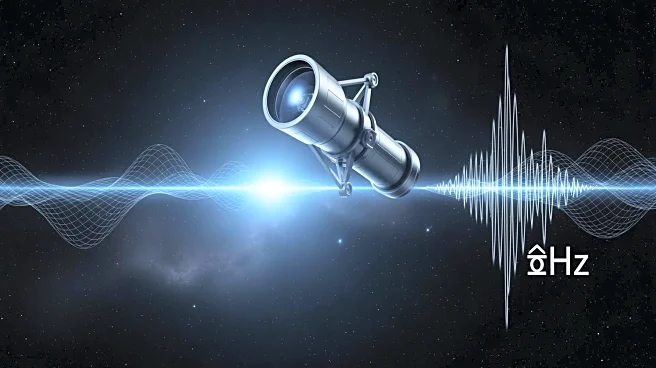
NASA's Nancy Grace Roman Space Telescope is set to detect microhertz gravitational waves, bridging a gap in the frequency spectrum not covered by current observatories. The Roman Galactic Bulge Time Domain Survey (RGBTDS) will utilize high relative astrometric
precision and a large number of observed stars to detect gravitational waves from supermassive black holes. This initiative aims to simulate data and explore survey designs to enhance the telescope's sensitivity to gravitational waves, potentially leading to significant advancements in understanding supermassive black hole binaries and their evolution.
Why It's Important?
Detecting microhertz gravitational waves opens a new observational window for studying the universe, particularly supermassive black hole binaries. This capability could provide insights into the formation and evolution of these massive cosmic structures, contributing to our understanding of the universe's dark side. The Roman Space Telescope's ability to detect these waves could lead to breakthroughs in astrophysics, offering a deeper understanding of gravitational wave backgrounds and the dynamics of supermassive black holes. This advancement underscores the importance of continued investment in space-based observatories to expand our knowledge of the cosmos.