


What's Happening?
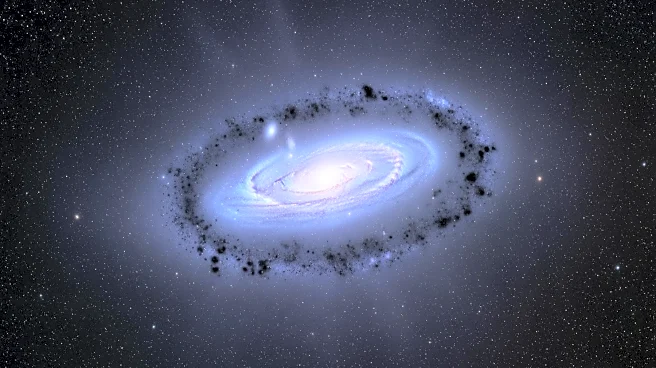
Astronomers have discovered a galaxy, named Candidate Dark Galaxy-2 (CDG-2), which is believed to be composed of at least 99.9% dark matter. This finding was made using the Hubble Space Telescope, and if confirmed, CDG-2 would be one of the most dark matter-heavy
galaxies ever identified. Dark matter, which is invisible and has never been directly observed, is inferred through its gravitational effects on regular matter. The galaxy, located about 300 million light-years from Earth, is so faint that it is almost invisible, a characteristic of what astronomers call 'low surface brightness galaxies.' These galaxies have a high ratio of dark matter to normal matter, resulting in sparse stars and faint visibility. The discovery of CDG-2 could provide insights into the elusive nature of dark matter, which is five times more abundant than regular matter in the universe.
Why It's Important?
The discovery of CDG-2 is significant as it offers a potential new method to study dark matter, a substance that plays a crucial role in the structure and formation of the universe. Understanding dark matter is essential for comprehending the universe's composition and the forces that govern it. The identification of such a dark matter-heavy galaxy could help scientists develop more accurate models of galaxy formation and evolution. Additionally, studying galaxies like CDG-2, which have minimal interference from regular matter, allows for a clearer examination of dark matter's properties and behavior. This could lead to breakthroughs in theoretical physics and cosmology, potentially impacting our understanding of the universe's fundamental laws.
What's Next?
Further observations are needed to confirm the dark matter content of CDG-2 and to explore its physical properties in more detail. Researchers plan to use advanced telescopes, such as the James Webb Space Telescope, to gather more data. This could help verify the presence of dark matter and refine the methods used to detect similar galaxies. The study of CDG-2 may also inspire new approaches to identifying other dark galaxies, potentially leading to a broader understanding of dark matter's role in the universe. As research progresses, the scientific community will likely focus on developing technologies and methodologies to observe and analyze these faint celestial bodies more effectively.
Beyond the Headlines
The discovery of CDG-2 highlights the challenges and complexities of astronomical research, particularly in studying phenomena that are not directly observable. It underscores the importance of innovative techniques, such as using globular clusters to infer the presence of dark matter. This approach could revolutionize the way astronomers search for and study dark galaxies, which have been largely elusive due to their faintness. The findings also raise questions about the formation and evolution of galaxies, particularly those that deviate from the typical star-rich structures. As scientists continue to explore these questions, the study of dark matter-heavy galaxies like CDG-2 could lead to a deeper understanding of the universe's hidden components.