



What's Happening?
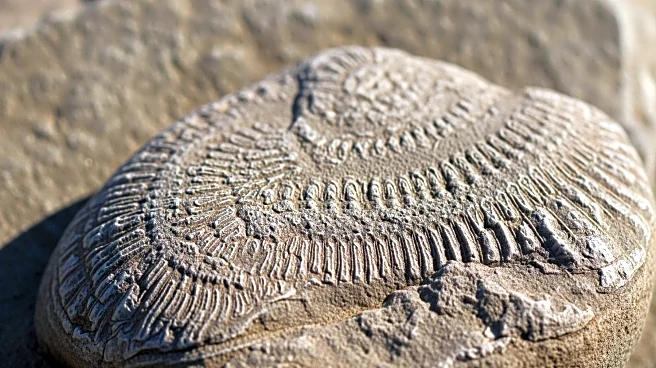
Researchers have made significant progress in understanding how the prehistoric Ediacara Biota fossils have been preserved for millions of years. A study published in the journal Geology reveals that these soft-bodied organisms, which existed before the Cambrian
Explosion, were preserved due to environmental conditions rather than biological durability. The research team, led by paleontologist Lidya Tarhan from Yale University, used chemical analysis to study lithium isotopes in sediments from Newfoundland, Canada. They found that clay particles in the sediment acted like natural cement, preserving the fossils by binding sand grains together and capturing detailed impressions of the organisms.
Why It's Important?
This discovery provides new insights into the fossilization process of soft-bodied organisms, which are typically not preserved in the fossil record. Understanding the preservation of the Ediacara Biota helps scientists explore the early evolution of complex life on Earth and the conditions that led to the Cambrian Explosion. The findings could reshape theories about the drivers of early life diversification and offer a broader perspective on the environmental factors that contribute to exceptional fossilization, enhancing our knowledge of Earth's ancient ecosystems.
Beyond the Headlines
The study challenges previous assumptions that the Ediacara Biota's preservation was due to inherent biological traits. Instead, it highlights the role of environmental chemistry in fossilization, suggesting that similar processes could have occurred in other periods of Earth's history. This research may prompt further exploration into the Neoproterozoic-Paleozoic transition, offering a deeper understanding of how ancient life forms adapted to changing environments and the potential for discovering other well-preserved fossil records.