






What's Happening?
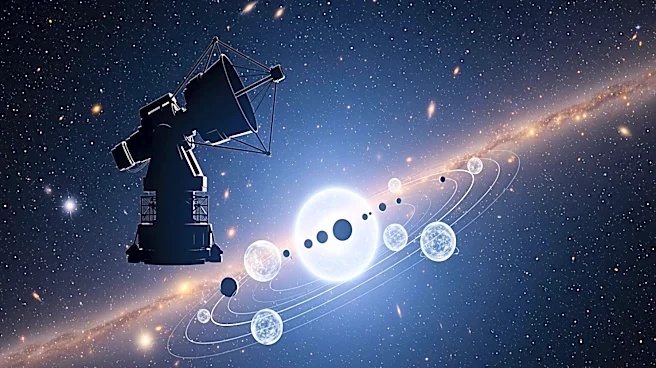
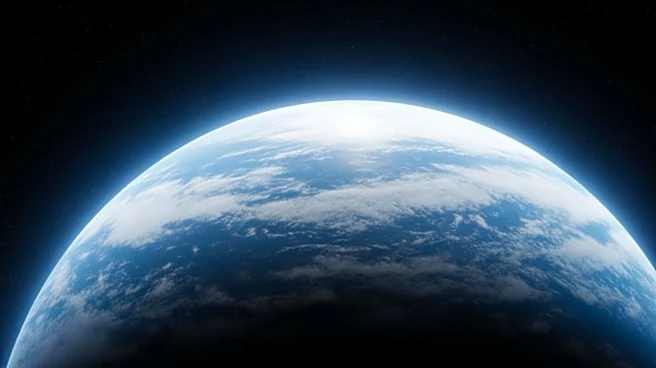
Astronomers have identified thick water-ice clouds on the exoplanet Epsilon Indi Ab, a Jupiter-like planet orbiting a nearby star. This discovery was made possible by the James Webb Space Telescope (JWST), which provided detailed atmospheric data. Epsilon Indi Ab is notable
for its cold, massive, and dim characteristics, with temperatures ranging from minus 70 to plus 20 degrees Celsius. The planet's atmosphere, containing patchy water-ice clouds, challenges previous atmospheric models that did not account for such cloud formations. The planet is more massive than Jupiter, with a mass of 7.6 Jupiter masses, yet retains a similar diameter. This finding is significant as it provides a closer analogue to Jupiter than previously studied exoplanets, which are typically hotter and closer to their stars.
Why It's Important?
The discovery of water-ice clouds on Epsilon Indi Ab has significant implications for the study of exoplanets, particularly those that are colder and more similar to Jupiter. This challenges existing atmospheric models and suggests that future searches for cold planets must consider the presence of clouds that can obscure certain atmospheric features. The findings also highlight the capabilities of the JWST in providing detailed observations of distant worlds, paving the way for more accurate atmospheric characterizations. This research could influence how scientists plan future observations and interpret data from upcoming space missions, such as the Nancy Grace Roman Space Telescope, which may further explore reflective cloud layers.
What's Next?
Future observations with the JWST are planned to further investigate the presence of water-ice clouds on Epsilon Indi Ab and to clarify the unexpected weak ammonia feature in its atmosphere. These observations will help refine atmospheric models and improve understanding of cold exoplanets. The research team aims to conduct additional photometry and spectroscopy from 3 to 20 micrometers to test their cloud hypothesis. The findings could lead to a reevaluation of how cold exoplanets are studied and understood, potentially impacting the design and focus of future space telescopes.