

What's Happening?
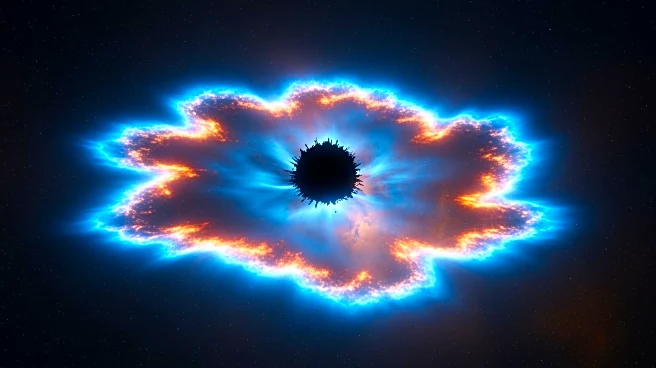
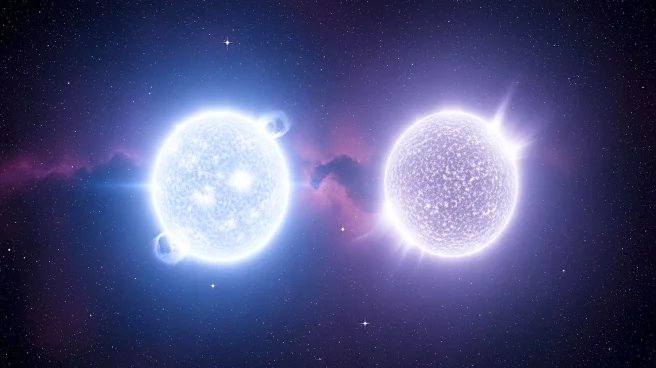
Astronomers using the Very Large Telescope (VLT) have discovered an unexpected shockwave around a white dwarf star, RXJ0528+2838, located 730 light-years from Earth. This discovery challenges existing theories about stellar remnants, as the white dwarf lacks
the typical disk of material that usually accompanies such stars. The shockwave, observed by the VLT's Multi Unit Spectroscopic Explorer (MUSE), is created as the white dwarf moves through space, pushing interstellar gas and forming a bow shock. The team, led by Simone Scaringi of Durham University, found that the shockwave has been maintained for over 1,000 years, a phenomenon not explained by current models. The presence of a powerful magnetic field is suspected to channel material from a companion star directly to the white dwarf, bypassing the formation of a disk.
Why It's Important?
This discovery is significant as it challenges the standard understanding of how matter interacts in binary star systems. The unexpected presence of a shockwave without a surrounding disk suggests that there are unknown mechanisms at play in these systems. Understanding these processes could have broader implications for astrophysics, particularly in the study of stellar evolution and the behavior of binary systems. The findings could lead to a reevaluation of existing models and theories, potentially impacting how scientists study and interpret similar astronomical phenomena. The discovery also highlights the importance of advanced observational tools like the VLT in uncovering new aspects of the universe.
What's Next?
To further investigate this phenomenon, astronomers plan to use the forthcoming Extremely Large Telescope (ELT), which is under construction in Chile. The ELT will allow for more detailed observations of similar systems, potentially revealing the mysterious energy source sustaining the shockwave. This could lead to new insights into the dynamics of binary star systems and the role of magnetic fields in stellar interactions. The continued study of RXJ0528+2838 and similar systems may provide answers to the questions raised by this discovery, contributing to a deeper understanding of the universe.