





What's Happening?
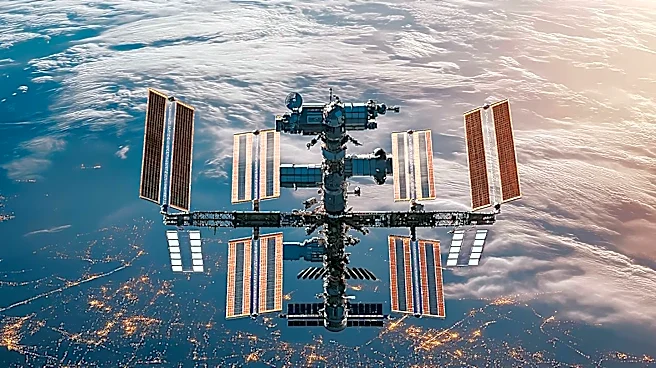
American astronauts aboard the International Space Station (ISS), including Anil Menon, Jessica Watkins, and Luke Delaney, have cast their ballots for the midterm elections from orbit. Astronaut Anil Menon shared his experience in a social media video,
highlighting his room on the ISS, which served as a voting booth. He used a computer to fill out an electronic form and sent it to Harris County, Texas, where NASA's Lyndon B. Johnson Space Center is located. This process is made possible by a 1997 Texas law that allows NASA astronauts to vote from space. Astronauts, like other Americans away from home, can request an absentee ballot by filling out a Federal Post Card Application. Once completed, the electronic ballot is transmitted via NASA’s Tracking and Data Relay Satellite System to a ground antenna.
Why It's Important?
The ability of U.S. astronauts to vote from space underscores the nation's commitment to democratic participation, even in the most extraordinary circumstances. This practice, established by Texas law in 1997, ensures that individuals serving the country in space do not lose their fundamental right to vote. It highlights the logistical and technological advancements that enable such civic engagement from a remote and challenging environment. For the U.S., it reinforces the principle that citizenship rights extend beyond terrestrial boundaries. This capability also serves as a powerful symbol of American ingenuity and dedication to democratic values, showcasing how technology can bridge vast distances to maintain connections between citizens and their government, regardless of their location.
What's Next?
As space exploration continues to expand with longer missions and potential human settlements on the Moon or Mars, the mechanisms for civic participation, including voting, will likely evolve further. The current system, relying on electronic ballots transmitted via satellite, provides a robust framework for astronauts. Future developments might include more integrated digital voting systems or international agreements to facilitate voting for multinational crews. The precedent set by the Texas law and subsequent NASA procedures will be crucial in shaping policies for future space endeavors, ensuring that the democratic rights of spacefarers are continuously upheld. This ongoing practice will also serve as a model for other nations as they develop their own space programs and consider the civic responsibilities of their astronauts.
Beyond the Headlines
The act of voting from space carries deeper implications beyond mere logistical convenience. It symbolizes the extension of human society and its foundational principles into the cosmos. As humanity ventures further into space, questions of governance, rights, and representation will become increasingly pertinent. The established practice of astronaut voting from the ISS provides a tangible example of how these challenges can be addressed. It also subtly reinforces the idea that space is not just a frontier for scientific exploration but also a domain where human values and societal norms will eventually take root. This practice could influence future discussions on space law, citizenship in extraterrestrial environments, and the development of democratic processes for potential off-world communities, emphasizing that even in the vastness of space, the essence of civic duty remains.