










What's Happening?
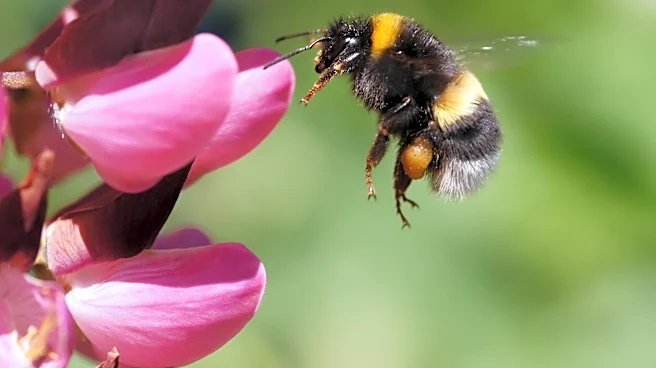
A study conducted by behavioral ecologist Olli Loukola has shown that bumblebees, despite their small brains, can solve complex problems similar to those solved by larger animals like chimps and elephants. The research involved training bumblebees to associate
a blue circle with a reward, leading them to move a Styrofoam ball to reach the reward. The bees demonstrated cognitive flexibility by adapting to new challenges, such as maneuvering around barriers to achieve their goal. This study highlights the advanced problem-solving abilities of bumblebees, challenging assumptions about brain size and intelligence.
Why It's Important?
The findings of this study have significant implications for our understanding of animal cognition and the evolution of intelligence. It challenges the notion that larger brains are necessary for complex problem-solving, suggesting that even small-brained creatures can exhibit sophisticated cognitive abilities. This research could influence future studies on animal behavior and intelligence, potentially leading to new insights into the neural mechanisms underlying problem-solving. Additionally, understanding bumblebee cognition can inform conservation efforts, as their ability to adapt to changing environments is crucial for their survival.