
What's Happening?
The U.S. Air Force has approved Boeing's T-7A Red Hawk program to proceed to low-rate initial production, marking a significant milestone in the development of this advanced trainer aircraft. The T-7A Red Hawk is designed
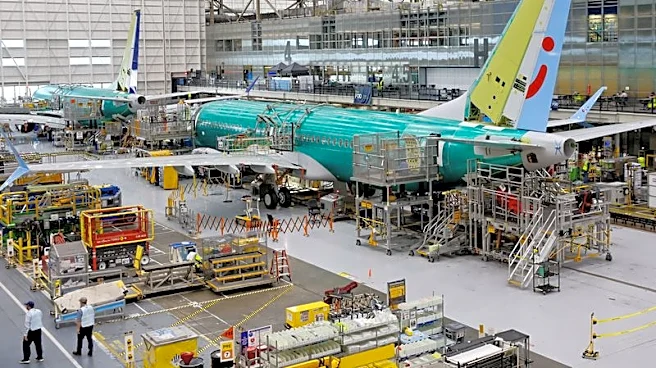
to replace the aging T-38 Talon, which has been in service since the 1960s. This approval, known as Milestone C, allows Boeing to begin producing aircraft intended for training future fighter and bomber pilots. Andy Adams, vice president and program manager for Boeing’s T-7 programs, emphasized the importance of this milestone for the program, highlighting the aircraft's digital design and production process. The U.S. Air Force's Rodney Stevens noted that Milestone C confirms confidence in the aircraft's design and readiness for production. The T-7A program, launched in 2018 with a $9.2 billion contract, includes 351 advanced trainers and 46 simulators. Production is ongoing at Boeing's St. Louis facility, with testing at Edwards Air Force Base.
Why It's Important?
The advancement of the T-7A Red Hawk program is crucial for modernizing U.S. military pilot training. The new aircraft is expected to provide enhanced training capabilities, ensuring that pilots are better prepared for modern combat scenarios. The program's reliance on digital design and production processes represents a shift towards more efficient and integrated manufacturing techniques, potentially setting a new standard for military aircraft development. This development also signifies a continued investment in U.S. defense capabilities, supporting both national security and the aerospace industry. The successful implementation of the T-7A could lead to further contracts and innovations in military training systems.
What's Next?
With the approval for low-rate initial production, Boeing will focus on manufacturing the T-7A Red Hawk and delivering the aircraft to the U.S. Air Force. Continued testing and evaluation will ensure the aircraft meets all operational requirements. The program's progress will be closely monitored by both Boeing and the Air Force, with potential adjustments based on testing outcomes. The successful deployment of the T-7A could influence future military procurement decisions and encourage further investment in digital design technologies.