
What's Happening?
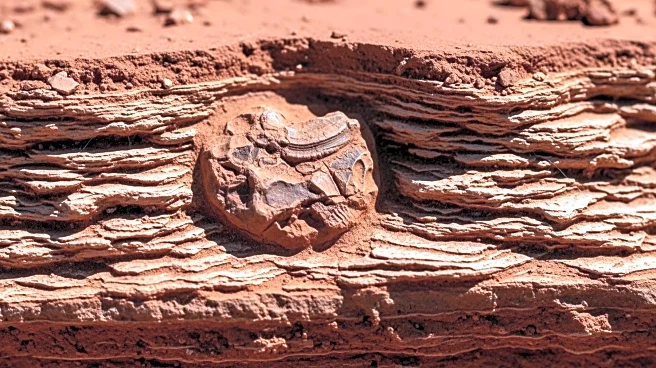
A new fossil discovery in the Talbragar Fish Beds of New South Wales, Australia, is challenging long-held beliefs about the origins of the Chironomidae family of insects. The fossil, identified as Telmatomyia
talbragarica, suggests a Gondwanan origin for these midges, contrary to previous theories of a Laurasian origin. The fossil's unique adaptation for turbulent freshwater environments, featuring a terminal disc for anchoring, provides new insights into evolutionary adaptations. This discovery, led by Viktor Baranov from the Doñana Biological Station, highlights the importance of Southern Hemisphere fossil exploration in understanding Earth's evolutionary history.
Why It's Important?
The discovery of Telmatomyia talbragarica has significant implications for the study of evolutionary biology. It challenges the prevailing view that many insect groups originated in the Northern Hemisphere, suggesting instead that the Southern Hemisphere played a crucial role in their evolution. This finding underscores the need for more comprehensive fossil exploration in underrepresented regions like Gondwana. By reshaping our understanding of insect biogeography, this discovery could influence future research directions and conservation strategies, particularly in biodiversity-rich areas of the Southern Hemisphere.
What's Next?
Researchers are now focusing on analyzing the genomic data of modern Podonominae species to better understand their evolutionary history and global distribution. This analysis could provide further evidence of the role of Gondwana in shaping the diversity of life on Earth. Additionally, the discovery may prompt increased fossil exploration in the Southern Hemisphere, potentially leading to more groundbreaking findings that could further alter our understanding of evolutionary processes.