






What's Happening?
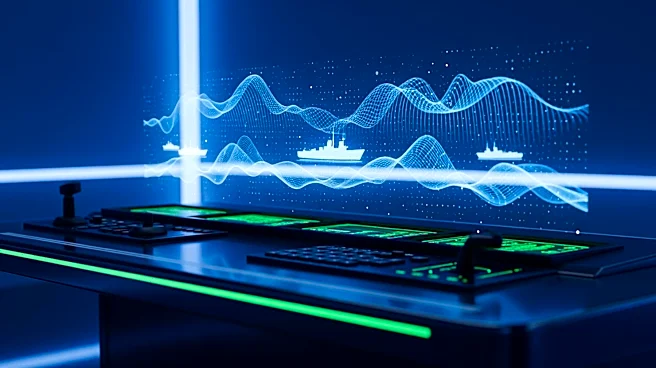
BAE Systems has introduced an AI-driven role-player capability for its Mimesis maritime battle simulator, showcased at the 2026 International Training Technology Exhibition and Conference (ITEC 26) in London. This new AI capability is designed to simulate
the maritime warfare environment by modeling the movement and behavior of ships, submarines, and other platforms. It digitally replicates their capabilities, including combat management systems, sensors, and effectors, and can also replicate threats and stimulate operational software. Richard Goldstone, BAE Systems' business development lead for maritime simulation and training, explained that traditionally, training a warfare team required a costly set of experienced role players. The new AI capability, developed by training a large language model, aims to replace these role players by providing accurate responses based on predefined roles and actions.
Why It's Important?
The introduction of AI in military training simulations represents a significant advancement in defense technology. By reducing the reliance on human role players, BAE Systems' AI capability can potentially lower training costs and increase the efficiency of military exercises. This development is crucial for the U.S. and its allies, as it enhances the realism and effectiveness of training scenarios without the logistical challenges of assembling large teams of human role players. The AI-driven approach also allows for more flexible and scalable training solutions, which can be crucial in preparing military personnel for a wide range of scenarios.
What's Next?
As BAE Systems continues to refine its AI role-player technology, further integration into other simulation platforms is likely. The success of this AI capability could lead to broader adoption across various branches of the military, potentially influencing training protocols and strategies. Stakeholders, including military leaders and defense contractors, may explore additional applications of AI in training and operational contexts, seeking to leverage the technology for enhanced readiness and strategic advantage.