
What's Happening?
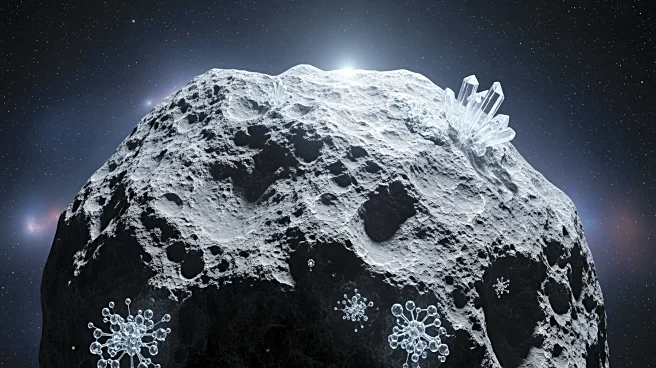
Researchers at Penn State University have analyzed samples from asteroid Bennu, brought back by NASA's OSIRIS-REx mission, and discovered amino acids, which are essential building blocks for life. The
study, published in the Proceedings of the National Academy of Sciences, suggests that these amino acids may have formed in icy-cold, radioactive environments in the early solar system, challenging previous assumptions that they required warm liquid water. The research, led by Allison Baczynski and Ophélie McIntosh, indicates that amino acids can form under a variety of conditions, expanding the understanding of how life's building blocks could have originated in space.
Why It's Important?
The discovery of amino acids on Bennu with different isotopic patterns than those found in other meteorites like Murchison suggests that Bennu and Murchison's parent bodies originated in chemically distinct regions of the solar system. This finding has implications for understanding the diversity of conditions under which life's building blocks can form, potentially offering insights into the origins of life on Earth. The research opens new avenues for studying the chemical processes that may have contributed to the emergence of life, highlighting the importance of analyzing different meteorites to uncover more about the pathways that create amino acids.