
What's Happening?
Researchers at the University of Copenhagen have developed a comprehensive model mapping the neutrino emissions from stars in the Milky Way. Neutrinos, often called 'ghost particles,' are elementary particles that
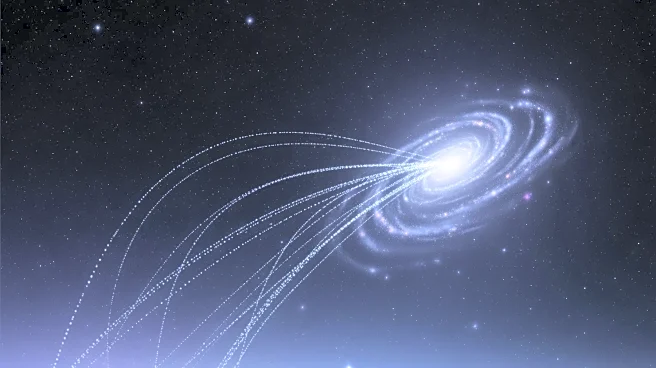
interact weakly with matter, making them difficult to detect. The study, published in Physical Review D, combines advanced stellar models with data from ESA's Gaia telescope to identify the primary sources of neutrinos within the galaxy. The findings indicate that most neutrinos originate from the galactic center, where star density is highest.
Why It's Important?
This research provides a detailed understanding of neutrino production in the Milky Way, offering a new tool for scientists attempting to capture these elusive particles. Neutrinos carry information from the core of stars, providing insights into stellar life cycles and the structure of the galaxy. The ability to map neutrino sources enhances the potential for breakthroughs in astrophysics and could reveal new physical laws. This study represents a significant step forward in utilizing neutrinos to explore the universe beyond traditional electromagnetic observations.
What's Next?
The new model serves as a roadmap for observatories aiming to detect neutrinos, guiding efforts to target regions with the highest emissions. As technology advances, improved detection methods may lead to more frequent and detailed observations of neutrinos, furthering our understanding of stellar processes and potentially uncovering new physics. The ongoing study of neutrinos will continue to expand the boundaries of astrophysical research, offering a unique perspective on the universe's most fundamental processes.