







What's Happening?
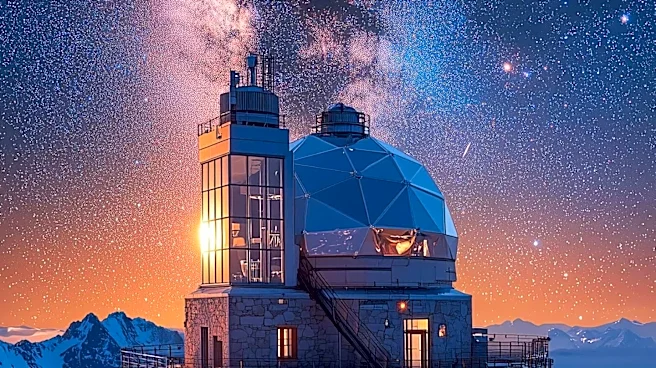
The Vera C. Rubin Observatory in Chile has commenced its 10-year Legacy Survey of Space and Time (LSST), utilizing the world's largest digital camera to create an unprecedented cosmic time-lapse. This project aims to scan the entire southern sky every
few nights, capturing high-definition images to study dark energy, dark matter, and potentially hazardous asteroids. The observatory's 3,200-megapixel camera, developed by the SLAC National Accelerator Laboratory, allows for rapid and detailed sky surveys. The project is funded by the U.S. National Science Foundation and the U.S. Department of Energy.
Why It's Important?
The Rubin Observatory's survey is set to revolutionize our understanding of the universe by providing insights into dark energy, a mysterious force driving the accelerated expansion of the universe. By distinguishing between competing theories about dark energy, the project could fundamentally alter our understanding of cosmic physics. Additionally, the observatory's ability to detect asteroids and other transient phenomena will enhance our knowledge of potential threats to Earth and the dynamic processes occurring in the universe. This research has the potential to inform public policy and scientific priorities in space exploration and planetary defense.
What's Next?
Over the next decade, the Rubin Observatory will continue to collect data, with scientists analyzing the findings to address key questions about dark energy and cosmic phenomena. The observatory is expected to discover millions of new asteroids and provide valuable data on transient events like supernovae and gamma-ray bursts. These discoveries will likely lead to new scientific inquiries and collaborations, further advancing our understanding of the universe. The project's outcomes could influence future space missions and the development of new technologies for observing and understanding the cosmos.