

What's Happening?
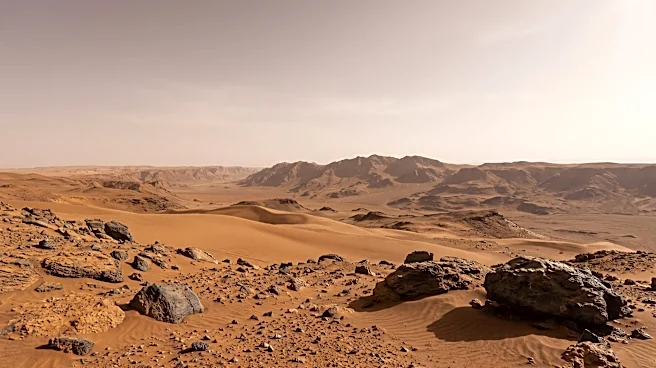
Hollywood films, such as 'The Martian,' often depict Martian dust storms with terrestrial violence, showing them capable of bending antennas, hurling debris, and forcing astronauts to flee. While Mars does experience winds up to 60 mph, and dust storms that
can span continents, the actual force exerted by these winds is significantly less than what is commonly portrayed. This discrepancy arises because Mars's atmosphere is approximately 100 times thinner than Earth's at sea level. Consequently, a 60 mph gust on Mars would exert a force comparable to a gentle 6 to 8 mph breeze on Earth. The key factor is atmospheric density, not just wind speed. The dynamic pressure, which determines aerodynamic push, is directly proportional to air density and the square of wind speed. Therefore, a much lower density on Mars drastically reduces the force of even high-speed winds. This scientific understanding, as noted by NASA, indicates that even the strongest Martian storms are unlikely to tip people or destroy major equipment in the dramatic ways often seen in cinema.
Why It's Important?
This clarification is important for several reasons, particularly in the context of future U.S. space exploration and public understanding of Mars. Accurate scientific representation is crucial for mission planning, astronaut training, and the design of equipment for Martian environments. Misconceptions perpetuated by popular culture could lead to an underestimation or overestimation of specific challenges. While the mechanical force of Martian winds may be less threatening than depicted, the dust itself poses significant hazards. Martian dust is fine, slightly electrostatic, and persistent, capable of coating optics and solar panels, fouling moving parts, reducing visibility, and altering thermal regulation of machinery. The historical example of the Opportunity rover, which ceased operations due to a planet-encircling dust storm blocking sunlight to its solar panels, underscores the real dangers of Martian dust, even if the wind force is minimal. Understanding these nuances is vital for developing robust technologies and operational strategies for long-duration human missions to Mars.
What's Next?
Future U.S. missions to Mars will continue to prioritize understanding and mitigating the effects of the Martian environment, including dust. Engineers will focus on designing habitats and equipment that can withstand the abrasive and pervasive nature of Martian dust, rather than solely focusing on wind force. This includes developing dust-resistant materials, self-cleaning mechanisms for solar panels and optical instruments, and robust life-support systems that can operate effectively in dusty conditions. Research will also continue into the atmospheric dynamics of Mars to better predict dust storm formation and movement, allowing for more informed mission planning and crew safety protocols. The development of advanced propulsion systems and power sources, such as nuclear power, could also reduce reliance on solar panels, thereby mitigating one of the primary risks posed by global dust storms. Furthermore, public outreach and educational initiatives will be essential to correct popular misconceptions and provide a more accurate scientific understanding of Mars.
Beyond the Headlines
The disparity between scientific reality and popular media portrayals of Mars highlights a broader challenge in communicating complex scientific concepts to the public. While dramatic depictions can engage audiences, they can also inadvertently create lasting inaccuracies. This issue extends beyond Martian storms to other scientific topics, influencing public perception and potentially impacting support for scientific research and exploration. Ethically, there is a responsibility for media to strive for accuracy, even when fictionalizing. For space agencies like NASA, this means continuously engaging in public education to bridge the gap between scientific findings and popular narratives. The long-term implications involve fostering a more scientifically literate public, which is crucial for informed decision-making regarding space policy, funding for research, and inspiring the next generation of scientists and engineers. The subtle yet significant difference in atmospheric density on Mars serves as a powerful reminder that extraterrestrial environments often defy Earth-centric intuitions, necessitating rigorous scientific inquiry.