
What's Happening?
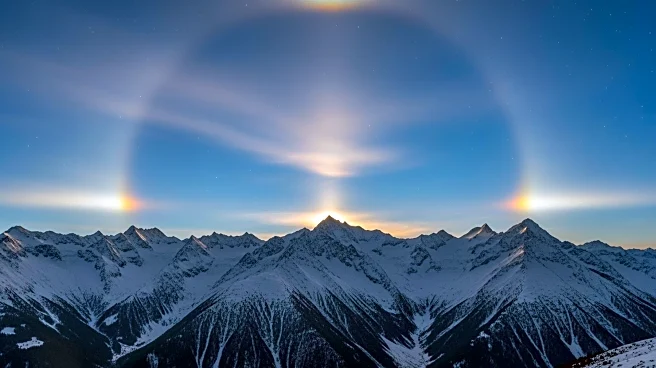
A photographer named Valter Binotto captured two rare atmospheric phenomena, an elve and a red sprite, in a single photograph over the Alps on November 26, 2025. These phenomena are transient luminous
events that occur during thunderstorms and are rarely observed due to their brief duration, lasting only milliseconds. An elve is a red ring that can reach up to 480 kilometers in diameter, formed when a lightning strike sends an electromagnetic pulse into the ionosphere. Red sprites, resembling jellyfish, appear between 80 and 145 kilometers above the ground. The simultaneous capture of these phenomena is unprecedented and provides a unique opportunity for scientific study.
Why It's Important?
The photograph taken by Binotto is significant as it offers scientists a rare chance to study these elusive phenomena, which remain largely mysterious. Understanding elves and sprites could enhance knowledge of atmospheric processes and electromagnetic interactions in the ionosphere. This could have broader implications for meteorology and atmospheric science, potentially improving weather prediction models and understanding of lightning-related phenomena. The rarity of such events makes this photograph a valuable asset for researchers aiming to unravel the complexities of these atmospheric occurrences.
What's Next?
The scientific community is likely to analyze the photograph to gain insights into the formation and characteristics of elves and sprites. Researchers may conduct further studies to explore the conditions under which these phenomena occur and their potential impact on the Earth's atmosphere. This could lead to collaborative efforts among meteorologists and atmospheric scientists to document and understand similar events in the future, potentially leading to advancements in atmospheric science and technology.
Beyond the Headlines
The capture of these rare phenomena also highlights the role of photography in scientific discovery, demonstrating how visual documentation can contribute to understanding complex natural events. This event may inspire further interest in atmospheric photography and encourage citizen scientists to participate in capturing and sharing similar phenomena, thereby expanding the data available for scientific analysis.