



What's Happening?
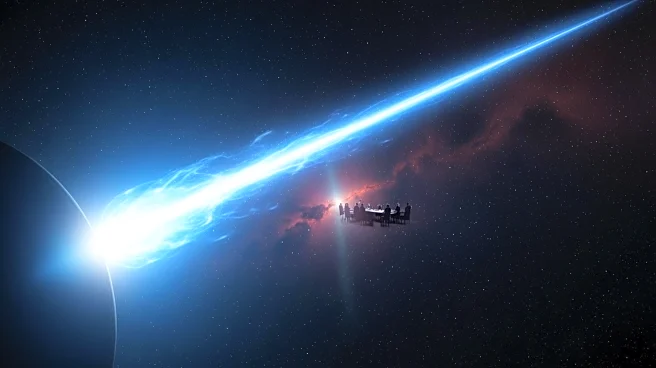
Astrophysical jets, observed across various celestial objects, are rapid outflows focused into narrow cones. These jets are seen in supermassive black holes, neutron stars, and young stars, despite their differing characteristics. Current research suggests
that jet formation requires rotation and magnetic fields, which interact with surrounding conductive gas to focus the outflow. This phenomenon remains an active area of research, as scientists seek to fully understand the mechanisms behind these concentrated jets.
Why It's Important?
Understanding astrophysical jets is crucial for comprehending the dynamics of various cosmic objects and their environments. These jets play a significant role in the transfer of energy and matter across the universe, influencing the evolution of galaxies and star systems. Insights into jet formation could lead to advancements in our knowledge of magnetic fields and their interactions with matter, potentially impacting theories of cosmic evolution and the behavior of extreme environments.
What's Next?
Ongoing research will focus on refining models of jet formation and exploring the role of magnetic fields and rotation in their development. Future observations with advanced telescopes may provide more detailed data on the structure and behavior of these jets, leading to a deeper understanding of their origins and effects. As technology improves, scientists hope to uncover the full complexity of these phenomena and their implications for astrophysics.